The Druids of Anuheim
An ancient order shaped by forest, moon, and season, detailing druid paths, shapeshifting rites, and the Dawnspire Council’s divided visions.
Jack Isath
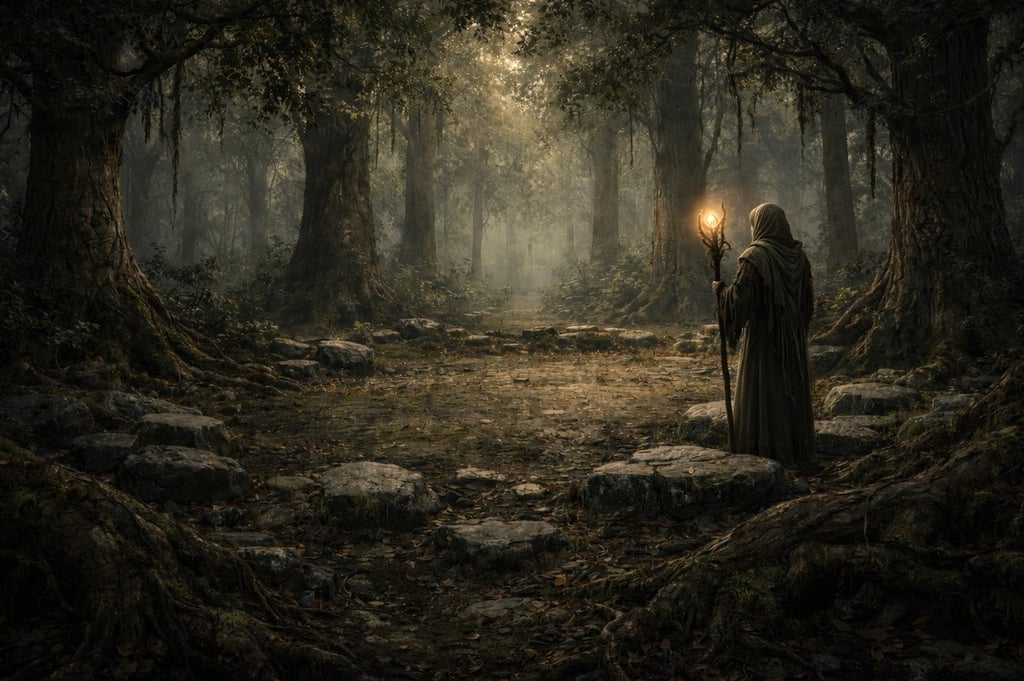
The druid’s call is not bound by race or bloodline, but by hunger for the forest’s strength. In the age after the Demonic Wars, when treants marched and roots tore through the wounds of battle, many felt this call anew.
The Silvanthar elves of Ebonhart have answered most strongly. For generations they strayed from their ancient bond, but now their youngest turn again to bark and branch. They mend scarred groves and weave their fate with the forest’s relentless expansion. In their enclaves, druids grow with the trees themselves, their power rising in step with the canopy.
A few humans have entered these circles, abandoning city and kin to walk beneath the Ebonhart. Even among the Chirry, birdfolk of the high boughs, some take up druidic rites. The Silvanthar shun them, but the trees do not.
Enclaves and the Dawnspire Council
Druids gather in enclaves bound by region or belief, each circle answering to its own grove, river, or mountain part of the forest. Yet above them stands a greater order, named for the Great Tree where it convenes: the Dawnspire Council.
From across Anuheim, enclaves send emissaries to the Dawnspire, each voice carrying the weight of its land. Together they seek accord, though their visions often clash. Some believe druids exist to heal the land’s scars. Others hold their duty is to guard its borders against human steel. Others still proclaim druids must embody the forest’s wrath, uprooting all who oppose its growth.
The Dawnspire binds them, but unity exists through fierceness of opinion. The forest is vast, and no single oath defines it.
The Many Paths
As the forest has root, bough, leaf, and thorn, so too do druids diverge into paths:
Shapeshifters: those who wear the hides of beast and bird, risking their souls to wield the fang and claw.
Nurturers: stewards of soil and sap, who draw sickness from wound and coax new growth from decay.
Protectors: wardens who bind themselves to grove, river, or road, standing firm as roots against axe, flame, and corruption.
Watchers: seers of the forest, attuned to moon and star, who read omens in the cycles of night and day.
Stormcallers: wielders of storm and fury, who bring judgment upon enemies of the wild.
Though all walk beneath the same sky, each path bears peril, for to embody one face of nature too fully is to risk losing balance.
Magic of Bark and Moon
The heart of druidcraft is drawn from Nature-Earth, the power of bark, root, and stone. Vines that bind, branches that shield, thorns that pierce, and soil that renews.
Yet druids also channel the Arcane-Mind, not through glyphs or shards, but through the eternal cycles:
The waxing and waning of the moon.
The rising and setting of the sun.
The turn of equinox and solstice.
The tide of seasons, eternal and unbroken.
Through these patterns they call strength to nurture, to transform, or to destroy.
Shapeshifter Forms
The forms most often taken are those of beast and bird that rule the forest:
Wolf
Werewolf
Bear
Tiger
Panther
Fox
Snake
Moose
Owl
Hawk
Some take rarer shapes like stag, raven, or serpent of the river but all demand ritual, risk, and surrender. The werewolf remains the most feared, a form of savage strength that few dare to master.
The Common Paths
Most druids walk as nurturers, protectors, or stormcallers, for these paths heal the forest’s wounds and stand against corruption’s return. Shapeshifters are uncommon, and watchers are rare, for both tread too close to the edges of madness and solitude.
Lore
Explore rich lore from the fantasy setting on Anuheim
Adventure
Quest
Jackisath@Gmail.com
© 2026. All rights reserved. Created by Nectagrity