
The Tyrian Morass
A vast swamp of deltas, fungus forests, undead ruins, rare resources, fierce peoples, and the wailing presence of Nalythra, the Drowned Queen.
Jack Isath
The Tyrian Morass spreads where great rivers unmake the land. From the west the Westhart River spills out of the Ebonhart lowlands into black water, muck, and mushroom forests. From the east the Ashen River pours its burden of melt and silt into the same basin. Their deltas meet and tangle, layer after layer of mud and root and drowned stone, until the whole expanse merges with the ocean. The Morass is breadth and depth together, a waterworld of shifting channels, hidden sinks, and pockets of hard ground that endure through every season.
Regions of the Morass
Westhart Delta
The Westhart carries warmth and life from the forest, spreading broad sheets of slow water across reeds and willow curtains. Here the banks collapse and reform with each flood. Groves of swollen cypress stand like pillars, their knees jutting from black water in ranks. Veymar and Groakyn boats run these lanes at all hours.
Ashen Delta
The eastern river comes colder and harsher, laden with gravel and silt scoured from high country. Its distributaries bite deeper and its floods cut harder against the ground. Lakes here form wide and dark. Marsh creepers linger in these basins when they are not roaming the waterways, and the largest constrictors coil through drowned brush that never truly dries.
The Fungus Reaches
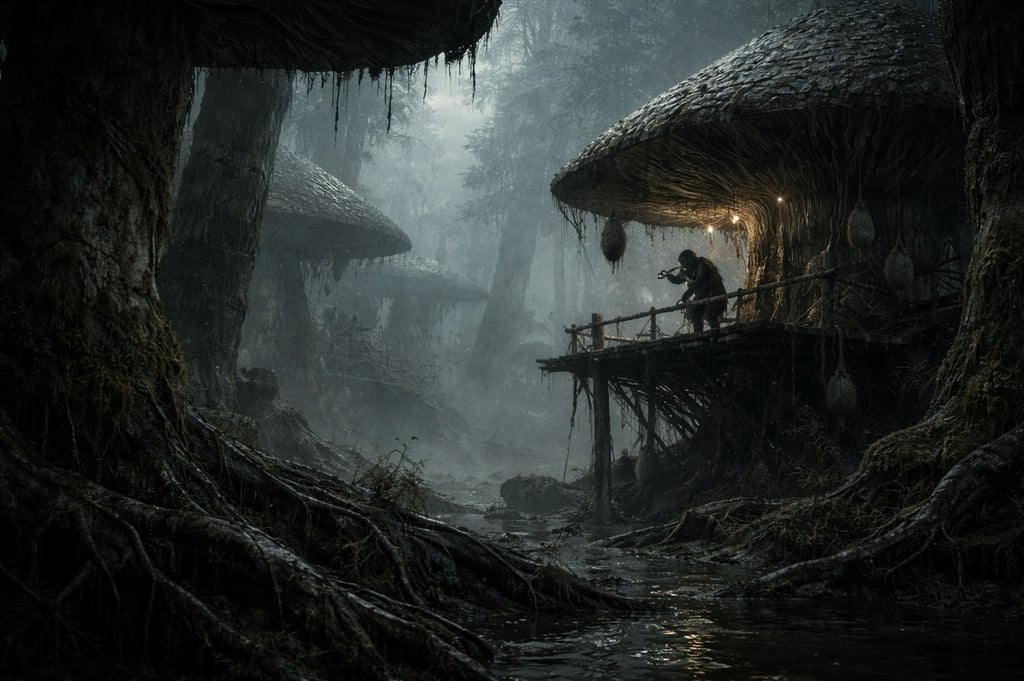
Mushroom forests rise where mists settle thickest. Most span smaller than a square mile, each a self-contained world of towering caps, lattice roots, and spore haze. Two are known across the Morass for their size and fortification… of goblins. Murkore and Murlim, which the Murklin goblins claim and defend with cruel brutality. Beyond these strongholds, solitary giant mushrooms continue to stud the wet country like lonely watchtowers between the clustered mushroom trees.
The Sunken Heart
Where the two deltas meet, the ground drops into a flooded temple of ancient stone. Shattered pylons and half-buried avenues still hold a line through the mud. In the midst lies a temple complex long ago swallowed. Within those halls rests Nalythra, the Drowned Queen, whose wail carries across the waterways. The old waymarkers near the Heart still guide the patient, great pylons now sunk to their shoulders and undead wandering as hopelessly as Nlythra herself.
Water and Season
Monsoon rains and snow melt flood the swamp in their time, swelling the deltas into one wide sheet. Lower tides bring the margins into breath again, though a skin of water remains over most ground in every season. The Morass keeps to these rhythms.
Waypoints and Travel
Waterways are the roads. Canoes, poleboats, and reedcraft move along known lines that hold their shape even as banks shift. Causeways of piled root and shell bind certain stretches, especially near Groakyn outposts and the Veymar dry-rises beyond their towns. In the Sunken Heart the old pylons still stand enough to mark a safe thread between submerged walls. Travelers pass from waymark to waymark, mooring at stilt homes, tree hollows, and market docks that rise a little above the flood.
Peoples of the Morass
The Groakyn
Frog-folk of honor whose colors gleam against the fog. They hold great swamp-trees as cities, shaping hollows within roots and chambers above the flood line. Mud-burrow villages on higher rises serve as waypoints and harvest sites along the trade routes. They fight the beasts of the waters to keep their reaches safe and they keep their oaths as law. Their trade runs mostly by barter, their diet favors fish and insects, and their boats are a common sight with the morass.
The Veymar
Human kin whose name means those of the waters. Their houses stand on stilts made of cypress and willow over ground hard enough to carry a village through every season. They hunt, fish, and gather across the deltas . The Groakyn trade openly with them along shared routes. Freeport’s caravans buy their goods with silver and contracts, and place a small station in the Veymar capital dry-rise to coordinate supply and demand. Service there is seen as a punishment among Freeport’s officials, yet the post keeps the city’s tables stocked with valuable herbs and fashionable hides. A single shipment of rare materials or a cart stacked with crocodile skins can secure iron, salt, and cloth for a family’s year.
The Murklin
Swamp goblins who make their homes in the mushroom forests. They eat fungi in every form and harvest spores for shamanic craft. Their shamans wield bralm, a spore-sorcery empowered by the Murklic Amber shards, living fungus, and Morass water. Robes grown from enchanted mushrooms, masks that strain poison mists, and staves heavy with spores mark their rank. Many would-be shamans perish during their fevered rites, stumbling into wildlife or black water
pools as visions take them. Those who survive command magic of healing and plague with equal ease. The Murklin raid villages, usually one another, along rivers and lanes with swift canoes and poison darts, and hold Murkore and Murlim as strong places among the Reaches. Less civilized or perhaps just less organized than their forest brethren, the swamp goblins are a more excitable and wild bunch.
Nalythra and the Undead
Nalythra, once a blue dragon of storm and ocean, drowned on the floodplains that formed the Morass. A powerful necromancer bound her back to service in undeath during the war against the Demonlords, then fell with the curse left in place. She haunts the Sunken Heart, a fallen capital city flooded and torn to ruin. Today she is rarely seen flying on skeleton wings with necrotic sorcery. Her breath carries shadow-void mind fracturing fury. Her necrotic plague spreads undeath raising the dead wherever she is.
Thousands of dead from the drowning of that age still wander, and the Cult of Nalyth, necromancers and dragon worshippers, raise more to stand watch around the Temple of Nalythra where she slumbers away her days. She’s heard at night wailing her sorrows as she mourns all that she’s lost in a hopeless and eternal fit. Occasionally she’s heard more loudly shrieking into the night and on these nights a terrifying phenomenon overcomes the swamp as fog of mind fracturing magic floats through the quagmire.
Magic, Shards, and Crystals
Bloodcrystals harden where great trees drive roots deep and drink the forest’s magic. In the Morass they surface rarely and often stay hidden in the muck. Families trade small finds for steady goods. There are no mines. Myric shards seldom form here. Murklic Amber appears in the higher ground of mushroom forests and fuels Murklin bralm. Mire kraken yield black pearls that necromancers prize. No other shard runs in the Morass. Scarcity seems to keep arcane rifts weak in the swamp. The Groakyn and Veymar raise few true casters who don’t learn their craft elsewhere. Murklin shamans thrive on the Amber they can find.
Weather and Strange Phenomena
Rain is a given in the morass. From light mists to heavy pours. But three patterns of strange phenomena occur in the morass.
The Spore Mists
Two mists move with the air when mushroom forests breathe heavy. One carries bright visions and laughter, bending the mind for a little while in mild hallucinations.
The other drapes incomes lethargy inducing the limbs in heaviness until thoughts slow and the body longs to sit in warm water and forget the day.
Storm Breath of the Drowned Queen
When Nalythra’s mood rises, a thread of her old storm wakes within her. She screams into cloud and night. Shadow-Void gathers in fog, then settles as banks of low cloud that fade over hours. Any who walk through these banks feel the mind divide into quarreling selves. The effect passes by morning, yet the memory of those brief strangers lingers.
Resources and Trade Goods
The biodiversity of Tyrian Morass is great and many resources are harvested but rarely can they be mass produced. There are hundreds of goods but some of them most notable are below:
Yaupon Holly
A swamp-edge shrub that yields a stimulating tea sought in distant halls. Local names shift by clan and town. Freeport’s nobility drink it at councils and long feasts. And it’s sold in town as a high end drink. Shipped across the seas at a premium to other nobles and wealthy people.
Nightweave Orchid
A pale flower that threads through moss in certain quiet pockets of the swamp. Its sap produces a clear, swift poison valued by assassins and court alchemists alike. Few ever see it. Those who find a single bloom earn a bag of coin if they know who to sell it to. This flower is banned and illegally smuggled into the world..
Fenroot
A hardy, common root used in teas and poultices. Demand always outruns supply. Veymar and Groakyn both gather boat loads near their homes to meet demand.
Crocodile Hide
Waterproof and tough. The Veymar cure it for their personal armor. Freeport and far ports prize the pattern for belts, bags, and small pieces that mark status at a glance.
Rootball Woven Armor
Hunters speak of Rootballs, living tangle of iron hard root monsters that rise from shallow waters and move with a slow, grinding will. Their woven roots hold the strength of iron with the weight of leather. Rangers and archers bind their chests and grips with it and swear by its balance.
Kraken Pearls
Black pearls from mire kraken circulate in black markets. Their ability to amplify Shadow-Void magic is highly prized. Necromancer in particular have found a liking to these pearls like no other.
Predators and Great Beasts
Mire Kraken
Solitary cephalopods that bury themselves in remote mire pools. They lash out with long, mud-caked tentacles, dragging prey beneath the muck. Prized for the rare black pearls that form inside their bodies, making them targets for dangerous hunts.
Fenback Turtle
Colossal snapping turtles that can remain dormant for as long as a decade, indistinguishable from swampy islets. Their shells carry moss, reeds, even small trees, giving them the appearance of floating landmasses. When awakened, their bite can sheer through boats and their bulk creates tidal surges in shallow waters.
Drowned Titans (Skeletal)
Towering skeletal colossi that stir most commonly when they hear the wails of Nalythra. Their frames are draped in moss and trailing weeds, their ribcages hollow but filled with vermin and muck. They wander like half-forgotten giants of bone and water, a moving omen of disaster.
Fungal Titans
Hulking forms covered in fungal growths, their true shapes lost under layers of muck and lichen. Their presence brings choking clouds of spores that poison the air. Slow moving and domineering in presence, they stick to the mushrooms forests rarely venturing away.
Blackwater Salamanders
Immense, amphibian predators that thrive in the deep blackwater lakes. Their bodies channel water and swamp-filth into torrents of high-pressure blasts, capable of capsizing rafts or battering through defenses but more commonly used to defend themselves. Glossy-skinned and smooth, they surface only at night, their movements rippling the entire lake basin. They love eating Gloom Bats that fly too close to their lakes.
Gloom Bats
Four-foot-tall when hanging, harpy-bat hybrids that fly in coordinated packs. Their shrieks pierce the night, disorienting prey before they descend in a flurry of claws and wings. Likely kin to harpies, they hunt by fear as much as by fang, turning dusk into a chorus of terror.
Freeport’s Hand at the Edge
Freeport posts a small station within the Veymar capital dry-rise to track prices, schedule barges, and relay demand from the city. Service there falls to officials who have angered their betters view this position as a punishment or demeaning often shirking their duties and letting smugglers bribe them or simply not even noticing illegal activities.
Even so, the post keeps goods moving and papers clean, which suits both swamp and city. Beyond the station, Freeport keeps no garrisons and raises no forts. Traders come and go with the season and the courage to match it.
The Veymar appreciate their presence as this alliance supplies them with weapons and basic resources like salt and dry timber. The Freeport presence also creates a welcoming environment for adventurers who help keep the swamp safe as well as bring in coin.
Relations and Tensions
Groakyn and Veymar trade as neighbors bound by water routes and common dangers. The Murklin raid when hunger or ambition stirs but mostly raid each other due to proximity. The Cult of Nalyth works in secret near the Heart, drawing power from grief and shadow and setting guardians to wander. A small coven of warlocks hides somewhere deep, more interested in being lost than being found.
Why the Morass Holds
The Tyrian Morass endured the Demonic Wars because its heart, where Nalythra drowned, was lost early on and flooded by the Ashen River calamity. Crushed and forgotten, the few who endured lived hidden amongst the dark waters and thick fog.
Water everywhere to swallow fires and slow marches. It remains the same kind of refuge and hazard now. Life and death move together here. Trade and danger keep pace. The dead have their queen, the living have their lanes, and the Morass keeps its own counsel beneath mist and rain.
The Groakyn
The Groakyn dwell where the Ebonhart decays into the Tyrian Morass. Their lives are bound to the waterlogged earth and the great swamp-trees that rise from it. These trees grow broader than their forest cousins, draped in willow-like curtains and crowned with cypress knees that thrust from the black waters like watchful sentinels. Beneath such roots and within their vast hollows, the Groakyn carve their cities.
Though reclusive, they are not wanderers. They fight the swamp’s beasts to carve havens of peace, and from those havens their lives endure. Villages of mud-burrow homes dot the rare dry rises, waypoints along the waterways that wind through the Morass. Such places serve as both shelter and store, where hunters, trappers, and gatherers pause before returning to the great trees.
The waterways are their roads. Although great swimmers, they use canoes and reed-boats on the shifting currents, laden with fish, insects, and swamp-harvest goods. The Groakyn economy is one of barter and craft, their tools shaped for survival: spears, nets, woven traps, and boats that skim the shallows. They raise insects for food but till no fields, for the Morass gives freely to those with frog’s patience and appetite.
Honor binds them more tightly than law. Oaths sworn among Groakyn carry weight greater than blood, and exile is the punishment for betrayal. Those cast out seldom survive long, for beyond the protection of one another lie only beasts and silence.
Most Groakyn remain close to their waters, but some are driven outward: hunters seeking greater prey, traders bold enough to barter beyond the swamp, or exiles with no home to return to. Such wanderers are rare, yet when found they cling to rivers, lakes, and coasts, for the dry lands are death to them.
Some speak of kin who long ago turned from the Morass and made their homes upon the ocean’s edge, scattered among islands and sandy shores. These shoreborn cousins are less bound by oath, and more prone to aggression, but the same bright colors shine upon their skin, and the same hunger echoes in their voices.
In the Morass, the Groakyn are guardians and survivors. They are born among the reeds, Swamp’s Watch, those who hold the waters safe where all else would drown.
Nalythra, the Drowned Queen
Once she was Nalythra, a blue dragon whose storms shattered demon hosts in the waxing years of the Demonic Wars. Thunder and lightning broke their ranks until the tide turned against her. In the floodplains that later drowned into the Tyrian Morass, she fell and her body crushed, her lungs filled, her roar silenced beneath black water.
A powerful necromancer found her there. In desperation he bound her soul back into flesh and bone, raising her as a weapon of death to hurl against the Demonlords. Now, the necromancer is long gone, fallen in the war, yet when her master perished, the spell did not end. The curse
held her in undeath. She rose still, wings torn and sodden, her flight now carried only by her own necrotic sorcery.
She dwells at the Morass’s heart in a drowned ruin, a temple half-swallowed by mire whose shattered spires jut like broken ribs above the fog. By day she prowls in silence; by night, her keening echoes across the waterways, a cry that unravels thought and courage. Where once her breath was storm, now it is but shadow. Those caught within her necrotic plague wither and their minds splintered by void-born whispers, bodies seized by necrosis. Where she passes, the dead rise, dragged back into mockery of life by her endless grief.
Nalythra embodies the swamp, her final resting place. Necromancers gather to her as worshippers and carrion of her magic. Some claim she grants them fragments of her curse; others say she does not see them at all, that they are insects feeding upon her eternal wound. Still, they pursue, for in her shadow their magic grows sharper, their power deeper.
She is no longer daughter of storm, no longer kin to her kind. She is ruin made flesh, chained to the waters that drowned her. To name her is to summon dread: Nalythra, the Drowned Queen of the Morass.
The Veymar Swamp People
In the Tyrian Morass dwell the Veymar, a people as old as the swamp itself. Their name means “those of the waters” in their native tongue, a word carried through centuries of survival. They are humans hardened by generations of storm, hunger, and fog, living where land rises firm enough to hold a village through every season. Their houses are built on stilts of cypress and willow, roofs thatched with reed, smoke from their warm and drying fires is always drifting above the waters.
The waterways are their roads. They craft rafts that float in every level of water and weave nets as deftly as Freeport’s smiths hammer steel. Fish, crayfish, and crocodiles fill their traps; berries, roots, and herbs line their baskets. The swamp provides in plenty to those who know its moods, and the Veymar know them well. They are gatherers and hunters, traders and craftsmen.
Their trade carries them around and beyond the Morass. The Groakyn barter openly, exchanging reedwork, swampstone tools, or fish for herbs and hides. Caravans from Freeport welcome their goods with open purses, for nobles prize swamp herbs rare enough to heal or intoxicate, and crocodile hides beautiful enough to turn eyes. A single cart of such trade can secure a family’s iron, salt, and cloth for the year. Yet though their wares are desired, the Veymar themselves meet disdain if they step within Freeport’s walls and certain towns, regarded as unwashed folk of the mire. The Veymar care little; they return to their waters with all they need.
The Morass breeds enemies. Murklin goblins raid their boats and villages, vanishing into muck and shadow with plunder. The undead wander freely, drowned soldiers and beasts risen by the
curse of Nalythra. Spears, nets, and crocodile harpoons are no longer enough; steel from Freeport lines their homes, weapons bought with the wealth of swamp bounty.
The Veymar live close to death, and so their culture grows rich in story and song. Their voices rise at night over the waters, carrying tales of ancestors, of hunts, of storms weathered. Drums carved from cypress trunks echo in their gatherings, and dances mimic the leap of frogs or the lunge of crocodiles. They paint their faces with swamp clay during festivals, marking kinship and memory. Children grow hearing the name of Nalythra, the Drowned Queen, not as myth but as presence because her wail drifts through the fog like a horn in the night.
The Veymar are the Morass given voice. They endure where others drown, they trade where others falter, and they sing where others fall silent.
The Murklin Swamp Goblins
In the Tyrian Morass, where mushroom forests rise like pillars of rot and rebirth, dwell the Murklin. They are goblins of the swamp, kin to the Skragglin of Ebonhart yet made stranger by the mire. Their skin runs mottled green and black, their eyes wide to pierce the mist. Homes are carved into fungus-stalks thick as towers, or woven from reeds and hung beneath the caps of colossal mushrooms.
Mushrooms are their lifeblood. They eat them raw, dried, and brewed; they dye their hides and tan their leathers with them; they steep them into poisons and powders for war. Yet above all, the Murklin harvest spores for shamanic craft. For it is in the mushroom forests that shamans are born.
Shamans and Bralm
Murklin shamans stand apart. They are vessels of bralm, a sorcery steeped in Murklic Amber shards, spore clouds, and the black waters of the Morass. Bralm cloaks warbands in choking fog, rots flesh into sickness, and calls forth visions from the depths of madness. Shamans wear robes grown from enchanted fungi, their masks woven to breathe amid spores that would choke others. Staffs drip with glowing amber, heavy with spores ready to be loosed.
The gift of bralm comes with peril. To walk its path, a goblin must gorge upon mushrooms until the world bends. Most never return from these visions. They dance, babble, or laugh themselves into the jaws of crocodiles or into the coils of swamp serpents. Villagers watch them stumble into bog and never rise again. Those few who survive the ordeal emerge scarred but changed, their voices carrying weight that commands both reverence and fear.
A Murklin shaman may heal their tribe with spore-breath or condemn them to plague. Tribes call them savior and curse-bringer in the same breath. To live under a shaman is to walk a path of trusting their power yet dreading the day it fails.
The Murklin Way
Not all Murklin are shamans, in fact, most are not. Most hunt, fish, and trade like any swampfolk. They weave nets from swamp-grass, hollow reeds into blowpipes, and lay traps for crocodiles, snakes, and men alike. Warbands strike swiftly by canoe, spears and arrows dipped in poison, wooden shields painted with spore patterns meant to dazzle and terrify. Their laughter carries far in the fog, harsh and mocking.
They raid and fight for rights to waterways, food, and plunder. The Morass itself gives them enemies enough yet still they thrive, for the Murklin are quick, cunning, and relentless as mold.
To outsiders, the Murklin seem feral, even foolish. They see goblins stumbling drunken on mushroom feasts, shrieking with visions no one else can see. Yet those same goblins may rise the next night to raid and ambush those that would laugh at them.
Lore
Explore rich lore from the fantasy setting on Anuheim
Adventure
Quest
Jackisath@Gmail.com
© 2026. All rights reserved. Created by Nectagrity