
Undeath and Necromancy in Anuheim
Explore undeath in Anuheim, from necromantic bindings and undead behavior to great nexuses like Samazinhold, the Sunken Heart, and the Great Ossuary.
Jack Isath
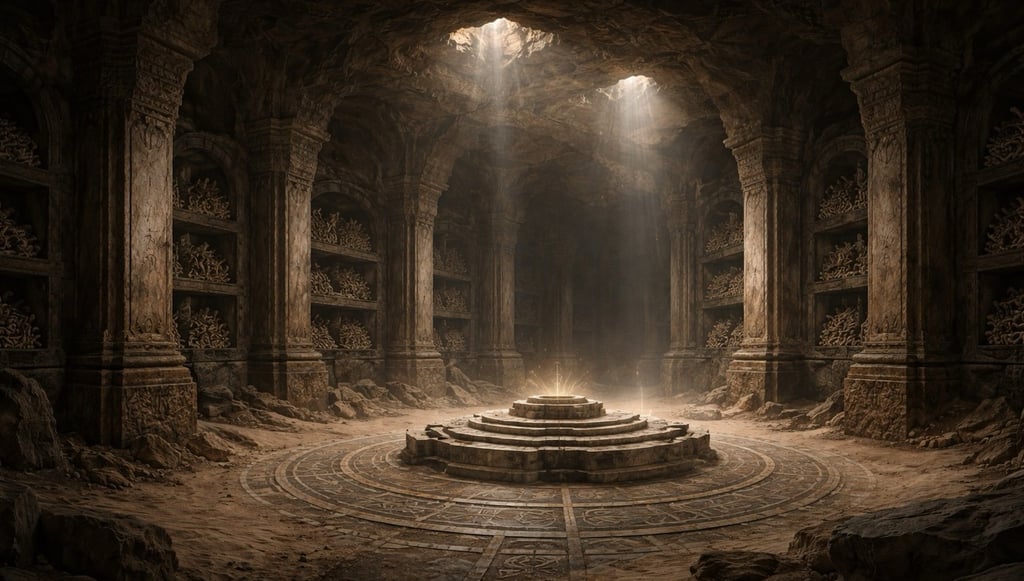
In Anuheim, the term undead refers to deceased beings whose remains or spirits have been reanimated or bound through necromantic means, resulting in continued motion, presence, or agency beyond death. Undead fall broadly into two categories.
Reanimated corporeal undead include skeletal remains, drowned bodies, preserved or mummified forms, and armored remnants animated through necromantic force. These entities retain physical mass and interact directly with the material world.
Incorporeal undead consist of wraiths, shades, and bound echoes. These are manifestations of spirit or memory anchored to locations, objects, or residual bindings rather than to intact bodies.
Draugr constitute a regional classification of undead distinct from both categories above. Though corporeal, they arise from sealed funerary traditions and curse-bound tomb practices specific to the Evareach Mountains, and exhibit behaviors and anchoring conditions not shared by other undead.
Scope and prevalence
Undead are rare outside established nexus zones. Their appearance is typically limited to areas where necromantic force is actively sustained or historically embedded.
Undeath does not propagate through proximity, contact, or transmission. Exposure to undead does not produce further undead without intentional necromantic action or the presence of an anchoring mechanism.
Undead density correlates strongly with several factors:
the presence of anchoring relics capable of sustaining necromantic force
ancient necromantic workings whose bindings have not fully decayed
ongoing activity by necromancers operating within or near a nexus
sites of mass death where binding conditions were imposed but never resolved
Principles of undeath
Undeath in Anuheim is sustained through binding. Without binding, necromantic animation collapses.
Binding sources
Master-bound undead are tethered directly to a controlling intelligence such as a lich, sovereign undead entity, or necromancer. Their behavior reflects command, coordination, and responsiveness to intent.
Site-bound undead are anchored to a specific geography. Temples, ossuary complexes, battlefield scars, and ritual grounds function as binding points, limiting undead movement to defined territories.
Relic-bound undead are sustained through artifacts that function as batteries, locks, or beacons for necromantic force. Destruction or removal of the relic typically results in rapid collapse of the undead.
Ward-bound undead arise when defensive ward systems are inverted or corrupted. Originally designed to repel intrusion or preserve sanctity, such wards instead animate and bind the dead as guardians.
Manifestation of binding
Binding is observable through consistent patterns of behavior.
Undead follow patrol routes, perimeter boundaries, and territorial lines that correspond to their anchoring source. When not actively engaged, they exhibit return behavior, drifting back to assigned paths, chambers, waterlines, or thresholds.
Clustering is non-random. Undead accumulate near doors, causeways, ritual rooms, river edges, vault entrances, and other liminal or structurally significant points.
Creation and raising
Raising refers to the forced reanimation of body and bone through applied necromantic force. The resulting undead are typically corporeal and directly controllable.
Calling involves drawing a spirit into a vessel or binding it to a place. This method produces incorporeal undead or hybrid manifestations tied to specific anchors.
Reconstitution assembles undead from fragmented remains, commonly drawing from ossuary stockpiles or mass burial sites.
Drowning-return is a form of water-bound reanimation associated with lake or temple nexuses. Bodies recovered from water rise as undead whose binding is reinforced by the surrounding environment.
Natural rising
Necromantic nexuses are capable of generating defensive undead without constant active casting.
Common triggers include intrusion thresholds being crossed, disturbance of wards, ritual cycles embedded into the site, and proximity to sealed or protected chambers.
Undead produced through natural rising differ from actively raised undead in several ways. They exhibit reduced individuality, more repetitive and constrained behavior, and significantly stronger territorial anchoring.
Behavior and combat characteristics
When unprovoked, most undead display lumbering movement, limited fine motor control, and little to no speech. Many repeat fragments of former tasks or patrol routines, mimicking actions embedded at the time of binding.
Sensing mechanisms vary by type. Corporeal undead respond primarily to heat, breath, blood, sound, and disruption of wards. Incorporeal undead respond more strongly to fear, focused attention, and proximity to thresholds or binding points.
Combat behavior
Undead exhibit a pronounced two-speed nature. In idle states they appear slow, heavy, and uncoordinated. Once engaged, they become unnaturally fast and forceful.
This shift is caused by necromantic reinforcement. A surge of binding energy, often described as a command pulse, overrides physical limitations. Joints and muscle constraints are bypassed through magic, and the absence of pain or fatigue allows sustained exertion beyond living capability.
Typical combat traits include coordinated swarming when undead are master-bound, ambush emergence from water, floors, or wall niches when site-bound, and relentless pursuit within territorial limits followed by abrupt disengagement when boundaries are crossed.
Chain of command
At the apex of necromantic control are sovereign undead such as liches, drowned queens, or comparable death entities. Beneath them operate adept necromancers who function within a nexus field, drawing amplification from its presence.
Lesser necromancers may exploit proximity to a nexus without controlling it, benefiting from reduced casting cost and increased binding stability.
Undead themselves function as bound instruments rather than independent agents.
Autonomy spectrum
Undead autonomy exists along a spectrum. Fully commanded undead display disciplined patrols and tactical behavior. Semi-programmed undead follow ward logic and defensive triggers with limited adaptability. Reflexive undead act through rage echoes or territorial response, exhibiting aggression without strategic coordination.
Necromantic Nexuses and Major Centers
Undeath in Anuheim does not arise evenly across the world. It concentrates where death has been shaped, bound, and sustained through ancient workings, sovereign will, or the convergence of relics and terrain. These concentrations are known as necromantic nexuses. Each functions differently, shaped by its origin, ruling force, and the nature of its bindings.
The most stable and enduring nexuses are Samazinhold, The Sunken Heart, and the Great Ossuary. Beyond these, lesser and regional manifestations exist, most notably the draugr traditions of the Evareach Mountains.
Samazinhold
Samazinhold is a ruined capital resting on the shores of Samazin Lake within the Ebonhart Forest. It is ruled by the lich An’cax and sustained by a corrupted legacy of ancient protective magic once used to resist the Demonlords. That same power now anchors undeath rather than life.
The city contains disciplined skeletal patrols, drowned corpses bound to the lake, and wraith-like remnants bound to ruins and thresholds. Despite its power, Samazinhold remains a contained necromantic domain rather than an expanding empire.
Location
Samazinhold lies at the heart of Samazin Lake, where stone causeways, broken bridges, and drowned districts meet the encroaching growth of the Ebonhart Forest. The Ancient Road once passed near the city, making it a strategic crossing point between regions. Its ruin now creates pressure on surrounding routes, forcing travelers and trade to skirt its influence rather than pass through it.
The lake itself serves as both moat and reservoir of undeath, with submerged streets and collapsed halls extending far beyond the visible ruins.
Ruling Entity: An’cax
An’cax is the sovereign lich of Samazinhold. His dominion is territorial rather than imperial. He does not seek conquest beyond his sphere, but control within it.
His purpose is preservation of authority, mastery of necromantic systems, and maintenance of the city as a functional engine of undeath. The undead under his command act with discipline and consistency, reflecting long-established control hierarchies rather than improvisation.
The undead largely remain within Samazinhold’s sphere because their bindings are tuned to the city’s wards, lake boundaries, and ancient defensive geometry. Outside these structures, their cohesion weakens.
Conflicts and Containment
Samazinhold exists in a long stalemate with the Hollow Veil Coven. Demonic corruption presses inward from the forest, while undeath holds its perimeter. Neither force expands decisively.
This balance, combined with the forest’s hostility and the lake’s natural containment, prevents Samazinhold from becoming an outward-marching undead empire. Its threat is severe, but localized.
The Sunken Heart
The Sunken Heart is an ancient temple complex buried beneath the Tyrian Morass. It is ruled by Nalythra, the Drowned Queen, an undead skeletal dragon. The site functions as an active necromantic nexus whose binding field naturally raises defensive undead and attracts necromancers seeking secrecy, protection, and amplification.
Location and Environment
The Sunken Heart lies beneath shifting channels, flooded basins, and living marsh. The Morass reshapes itself constantly, swallowing paths and revealing others only briefly. Fixed roads do not endure.
Access is achieved through memory, ritual landmarks, and temporary alignments rather than maps. Most who attempt to reach the temple without guidance are claimed by the swamp long before they near it.
The Morass conceals activity better than any stone fortress. Sound dies in waterlogged ground. Structures sink rather than stand. Tracks vanish within hours.
Ruling Entity: Nalythra, the Drowned Queen
Nalythra’s rule is not administrative. It is exerted through field dominance and binding authority. Her presence saturates the temple and its surrounding waters, enforcing hierarchy over undead within range.
The necromancy that birthed the Sunken Heart predates her rise. She did not create the nexus, but she commands it. Her will overlays older bindings rather than replacing them, creating a layered system of control.
Nexus Mechanics
The Sunken Heart sustains undeath through both residual and active necromancy. Long-dead workings maintain baseline animation and ward responses. Contemporary necromancers amplify, redirect, or exploit these systems.
Undead rise in defense rather than expansion because the field is structured around intrusion thresholds. Movement outward weakens bindings, while proximity to the temple strengthens them. The system is protective by design.
Necromancer Presence
Adept necromancers gather beneath the Sunken Heart because it offers what few places can:
• distance from states and organized retaliation
• terrain that kills pursuers before battles begin
• an undead perimeter that does not require constant maintenance
Within the nexus, cooperation exists only where necessity demands it. Rivalry is constant. Power struggles are restrained by the shared risk of provoking Nalythra’s attention or destabilizing the field itself.
The Great Ossuary
The Great Ossuary is a fabled interment complex built to house the remains of kings, nobles, and champions of a lost civilization that fell during the Demonic Wars. It lies hidden deep within a massive desert canyon beyond the Evareach Mountains, carved by the Ashen River.
It draws necromancers from across Anuheim, drawn by its relics, wards, and the remains of the high-status dead.
Location
The canyon lies far beyond settled lands, cut deep and sheer through arid stone. Its walls are vast, its floor broken, and its scale resists mapping. Routes shift with erosion, collapse, and seasonal floods.
The Ashen River is the only reliable corridor through the region. Even it vanishes at points beneath stone or ash-choked bends. The canyon’s depth and isolation make retreat as dangerous as approach.
Ossuary Function
The Great Ossuary was designed for preservation, containment, and ritual order. It includes:
Layered vaults and bone halls
Sealed procession routes
Warded locks keyed to bloodlines and sigils
Relic chambers bound to death resonance
It acts as a magnet because it combines immense bone supply, ancient ward systems, dense relic concentration, and centuries of accumulated necromantic pressure.
Necromancer Activity Patterns
Expeditions vary in scale from lone adepts to small warbands. Most aim to secure relics, claim remains of power, or establish footholds within the complex.
Failure is common. Rival necromancers, ward backlash, navigational collapse, and binding loss account for most deaths. The Ossuary does not forgive miscalculation.
Regional Undead Phenomena
Across Anuheim are centers of undead activity with little or no explanation as to why.
Draugr of the Evareach Mountains
Draugr are reanimated dead tied to sealed tomb traditions within the Evareach Mountains. They are most prevalent in the far eastern reaches, where wind-cut stone, ancestral crypts, and curse practices persist.
They are not sustained by nexus fields, but by sealed bindings and localized death rites.
Draugr emerge when tomb integrity is broken. Triggers include breach, curse activation, disturbance of binding relics, or necromantic harvesting attempts.
Unlike nexus undead, draugr are bound to specific burial sites and lineages.
Draugr are more territorial and memory-driven than other undead. They respond violently to desecration and pursue intruders with relentless focus.
In combat they display sudden speed, crushing endurance, and cold persistence. They do not retreat while their binding site remains threatened.
The Glowing Barrow of the Evareach is the most infamous draugr site, bound by legends of soul-locking necromancy. Unlike the great nexuses, it is isolated, sealed, and curse-driven rather than sustained by an open field.
Necromancers and the Economy of Undeath
Undeath in Anuheim does not persist through accident or entropy alone. It is sustained, expanded, and constrained through the actions of necromancers, whose craft forms an informal but powerful economy centered on death, binding, and control.
Definition and capabilities of Necromancers
Necromancers are practitioners of a dedicated magical discipline concerned with the arresting, redirecting, or sustaining of processes that would otherwise conclude in death. Their practice is distinct from warlock traditions and demonic binding, relying instead on controlled manipulation of death, life, shadow, mind, and material anchors.
Necromancy in Anuheim is not monolithic. Practitioners emphasize different techniques, materials, and philosophies, resulting in wide variation in method and expression. Some focus on the manipulation of souls and memory, others on blood and flesh, others on shadow-bound animation or blight-driven decay. These approaches coexist within the discipline and often compete rather than unify.
Core necromantic operations include:
Raising, the animation of body and bone through applied necromantic force
Binding, the anchoring of undead to will, site, relic, or ward
Commanding, the exertion of control over undead behavior and hierarchy
Ward inversion, the repurposing of defensive or preservative wards into necromantic systems
Soul-locking and vessel craft, the containment of spirit within bodies, relics, or constructed vessels
All necromantic practice requires anchors, maintenance, and either territory or authority. Undeath does not persist without continued support.
Variance within the discipline
Necromancers do not share a single doctrine. Techniques vary by region, lineage, and personal inclination. Some practitioners emphasize precision and restraint, others volume and attrition. Some work through blood and flesh, others through shadow and memory, others through decay and blight.
This variance produces distinct necromantic subtraditions that may differ radically in appearance and behavior while remaining part of the same discipline. Conflicts between necromancers often arise from methodological incompatibility as much as rivalry for resources.
The Necromantic Economy
Necromancy in Anuheim operates within an informal but well-understood economy centered on the acquisition, control, and exchange of death-derived resources. Unlike conventional trade, this economy values materials not for rarity alone, but for the authority, memory, and binding potential they retain.
Bones and remains
Bones are the most widely traded and utilized necromantic resource. Remains taken from beings of status, power, or historical significance are valued far above common dead. The bones of kings, champions, mages, and long-lived beings retain structural memory that strengthens bindings and stabilizes command hierarchies.
Sites of mass burial or honored interment are therefore of exceptional interest. Ossuaries, battlefields where elites fell, ancestral crypts, and sealed tomb complexes represent concentrated reservoirs of usable material. Even fragmented remains can be reconstituted or incorporated into larger constructs.
Control over burial sites is often more valuable than possession of relics.
Flesh and blood
While less durable than bone, flesh and blood are central to certain necromantic practices. Blood carries immediacy and vitality, allowing rapid raising, short-term empowerment, and volatile transformation. Such materials decay quickly and require constant replenishment, making them unsuitable for long-term structures but effective in active conflict or experimental work.
Because of this instability, flesh-based necromancy tends to cluster near sources of continual death rather than ancient tombs.
Souls and spirits
Souls are the most difficult and most dangerous resource within necromancy.
Unlike bones or flesh, souls do not persist reliably after death. Once the moment of passing concludes, the soul thins, disperses, or departs beyond reliable reach. For this reason, true soul capture is most effective at or immediately surrounding the moment of death.
Necromancers employ a variety of methods to intercept souls at this threshold, including ritual proximity, prepared vessels, sigil traps, and sacrificial bindings. Failure results either in loss of the soul or uncontrolled manifestation.
Ghosts, shades, and lingering echoes represent incomplete or degraded soul remnants. These may be bound or harvested, but they lack the coherence of a captured soul and are primarily used for anchoring, ward fueling, or limited command rather than true vessel craft.
Sites of death as resources
Locations where powerful beings have died are inherently valuable, even when remains are absent. Authority, memory, and trauma imprint upon the environment, strengthening necromantic workings performed there.
Battlefields, execution grounds, ritual chambers, and sacrificial sites function as latent amplifiers. This is why necromancers compete fiercely over historical locations and why nexuses tend to form where death was both significant and structured.
Implications
This economy explains necromancer migration, rivalry, and secrecy. It also explains why necromancers are drawn to ossuaries, battle ruins, temples, and disaster zones rather than population centers.
Death itself is the currency.
Control over where it occurred, and how it is remembered, determines power.
Why necromancers seek nexuses
Necromantic nexuses offer structural advantages that cannot be replicated through solitary casting.
Amplification
Within a nexus, necromantic workings require less energy to initiate, bind more tightly, and persist longer without maintenance. Raising is easier, bindings are stronger, and command structures stabilize more readily.
Security
Nexuses are often located in terrain hostile to intrusion. Swamps, ruins, deep water, forests, and canyons provide natural defense. Undead patrols reduce the need for constant vigilance, while distance from organized states limits retaliation.
Access to materials
Nexuses provide steady access to bones, relics, ancient wards, and accumulated death resonance. Some also contain rare necromantic materials, including Myric Shards aligned toward death and shadow. In the Tyrian Morass, for example, black pearls recovered from drowned depths are prized for their ability to stabilize and amplify necromantic workings, particularly those involving binding and drowning-return rites.
Nexuses as necromantic weather
Necromantic nexuses alter the conditions under which magic operates. Practitioners often describe them as regions of altered magical pressure rather than static locations.
Within a nexus:
Raising requires less preparation
Bindings hold longer and resist decay
Undead persist without constant reinforcement
Casting errors produce more severe backlash
The same forces that empower necromancers also magnify consequences. Miscalculations propagate through the field, destabilizing nearby bindings or drawing hostile attention from sovereign undead or rival practitioners.
Over time, this effect produces migration patterns. Necromancers drift toward established nexuses, abandon exhausted sites, and occasionally attempt to seed new ones where conditions permit.
Creation of new nexuses
The creation of a necromantic nexus is rare and catastrophic by design. Known conditions capable of producing one include:
Artifact anchoring, in which a powerful relic acts as a permanent necromantic engine
Mass death combined with binding ritual, transforming catastrophe into sustained undeath
Ward network inversion, repurposing large-scale defensive systems into necromantic frameworks
Sovereign undead establishment, where a lich or equivalent entity imposes enduring authority over a site
All methods are expensive, dangerous, and unstable. Failed attempts often result in partial nexuses that collapse, consume their creators, or attract external threats. Successful creation typically marks the turning of an age within the affected region.
Factions and Responses
Factions have varied responses to undeath and necromancers. Typically they are an unwelcomed group but not always. Some lawful order necromancers exist and are welcomed in many spaces, especially when they stay hidden.
Freeport and regional powers
Major states such as Freeport generally adopt containment doctrines rather than crusades. Direct assault on necromantic nexuses is costly, unpredictable, and often counterproductive.
Instead, states reroute trade, abandon compromised roads, restrict ferries and crossings, and enforce exclusion zones. Samazin Lake, for example, is avoided rather than challenged, while Morass routes are deliberately underdeveloped to limit access.
This strategy preserves stability at the cost of ceding territory.
Druids and nature-aligned powers
Druidic circles regard undeath as a violation of natural return-to-soil cycles and ecological balance. Death is acknowledged as necessary and irreversible. Undeath interrupts that conclusion.
Despite this, druids rarely pursue eradication campaigns against major nexuses. Where greater threats exist, such as demonic corruption or arcane rupture, containment of undeath is considered the lesser harm. Intervention focuses on preventing spread rather than restoring what cannot be returned.
The Hollow Veil Coven
The Hollow Veil Coven serves as a frequent point of confusion and contrast.
Warlocks of the Coven practice demonology, not necromancy. Their magic relies on binding external intelligences through contracts, sigils, and vessels. They do not raise or sustain undead.
Their goals intersect with undead sites only where relics, power, or strategic position overlap. Conflict between warlocks and necromancers arises from competition and incompatibility, not shared practice. Where undeath arrests death, demonic corruption consumes and reshapes it.
Closing Note
Necromancy in Anuheim is not an aberration but a discipline shaped by environment, history, and will. Its nexuses endure not because death is broken, but because it has been claimed, structured, and maintained.
Undeath persists only where someone chooses to hold it in place.
Lore
Explore rich lore from the fantasy setting on Anuheim
Adventure
Quest
Jackisath@Gmail.com
© 2026. All rights reserved. Created by Nectagrity