
The Ebonhart Forest
A relentless expanding forest of treants, dragons, goblin tribes, ancient ruins, living magic, faction conflict, and mysteries beneath its canopy.
Jack Isath
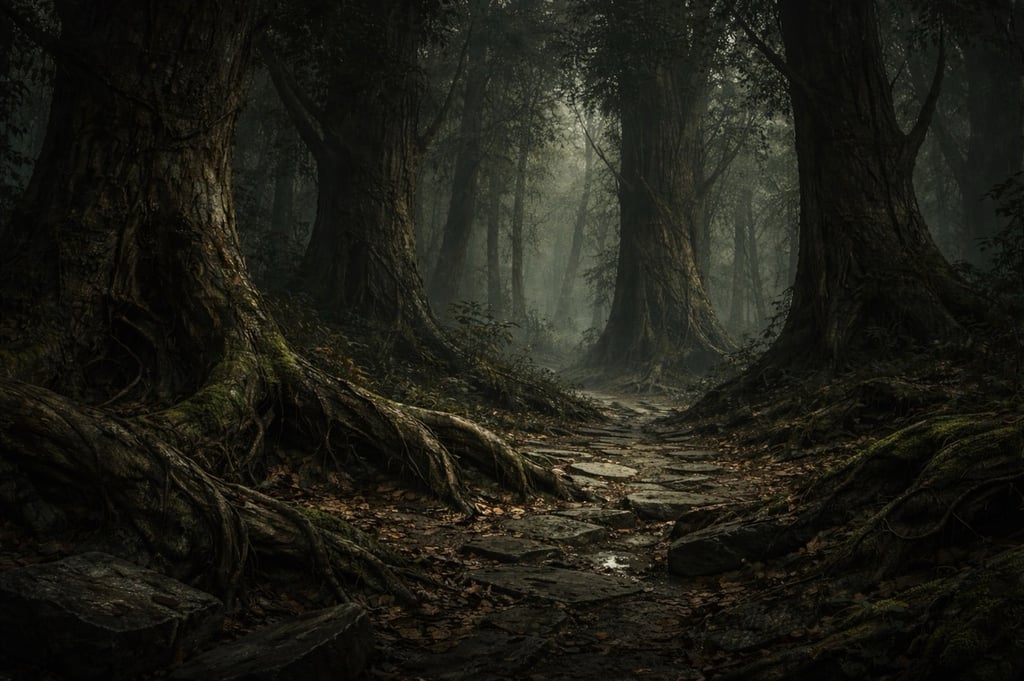
The Ebonhart Forest is not a land that rests. Each year its borders creep outward by miles, swallowing grassland, farmlands, and ancient roads beneath tangled roots and an ever-thickening canopy. Its trees grow tall and fast, their branches choking out the sun, their roots tearing through stone and soil alike. Left unopposed, the forest spreads without end, a slow but certain conquest of the land.
To the north, the Everreach Mountains rise as the only barrier strong enough to halt its climb. To the southwest, the nation of Freeport resists its encroachment, fighting with axe and saw to hold the riverlands and trade routes that sustain them. To the south and southeast, the forest presses to the ocean, where its shadows fall nearly to the cliffs and shores. To the west and northwest, its trees sink into the reeking mire of the Tyrian Morass, where forest becomes swamp. Eastward, the Ebonhart stretches into the uncharted, the so-called “unknown East,” a place from which few travelers return.
The forest’s unnatural growth began in the years following the demonic wars. The ancient treants, nearly destroyed by fire and corruption, rose from their long silence. No longer content to stand watch, they drive the forest outward, rooting new growth with relentless intent. To them, expansion is survival, each sapling a shield against the scars of war, each mile claiming a promise that Ebonhart shall never fall again.
Geography & Landmarks
The Westhart River
The Westhart River cuts through the forest’s western edge, its broad waters draining into the choking bogs of the Tyrian Morass. Wide and slow, it carries silt and life from deep within the Ebonhart, spreading its reach across the swamp like veins of shadowed water. Barges and rafts that enter its current seldom return, for the Morass swallows all who drift too far.
The Everbloom River
The Everbloom River winds from the heart of the forest toward the southwest, where it nourishes the grasslands and farmfields of Freeport. Though smaller in breadth than the Westhart, its waters are unusually warm, thick with nutrients, and rich with endless herbs and flowers blooming. Along its banks, plants flower in every season. Freeport prizes its harvests, for the river’s bounty brings both healing and trade. Many say it is access to the Everbloom that fuels Freeport’s defiance against the forest’s advance.
The Tyrian Morass
Where the Westhart River meets the lowlands, the Ebonhart decays into the Tyrian Morass. Here, trees sink beneath stagnant waters, their trunks drowned in muck, their branches smothered in moss. Mist hangs heavy, swallowing sound and sight. The Morass shifts with treacherous channels and unseen sinkholes, a labyrinth where even the Skragglin tread lightly. Those who vanish within its depths are seldom found, save for the echo of their cries.
Samazin Lake & the Ruins of Samazinhold
Deep within the forest lies Samazin Lake, vast and still, its surface broken only by the ruins of Samazinhold. Once a bastion against the demon lords, the city stood unbroken where all else fell. Its walls, fortified upon a jut of land, held against corruption through some ancient power long since hidden. Now, the city is a husk of it’s golden days, ruled by a lich, its streets patrolled by the dead, its waters filled with drowned shadows. Yet the ancient road still cuts through Samazinhold, and those who must cross the lake pass beneath the watch of its silent sentries.
The Ancient Road
The Ancient Road threads through the Ebonhart, a relic of kingdoms long lost. Though cracked and overgrown, it remains one of the few paths by which travelers may pass with speed. Merchants, explorers, and raiders alike risk its length, for it links Freeport to the Silvanthar elves and beyond to the Everreach Mountains. Goblin tribes use its stretches, laying ambushes where the underbrush conceals them. Still, the road endures, a scar of civilization carved through the forest’s heart.
The Great Trees & the Ebonspire
Rising above the canopy are the Great Trees, colossal giants that tower a hundred feet higher than their kin. Their crowns pierce the sky, their roots coil deep, fed by the magic of restless treants. The elves dwell within their branches, shaping cities into living wood. The Chirry claim others, nesting in heights no arrow can reach. Yet the greatest of them all is the Ebonspire Great Tree, lair of Vaelgorath, the Slumbering Rot. Its vast trunk is said to be wider than a fortress keep, its roots knotted through caverns rich with bloodcrystals. Many who seek power have set their eyes upon the Ebonspire, but few return from its shadow.
Safe Havens and Neutral Grounds
Freeport Watchtowers (1–3): Three towers stand along the first miles of the Ancient Road, each with minor fortifications and waystations supporting lumber crews and crystal expeditions. The third is remote enough that the Veilbreak Covenant has established a home base there for their own expectations.
Wood Elf Trading Groves: At set moon intervals, Silvanthar elves open glades where trade and parley may take place. These markets last only days, guarded fiercely, and vanish with the changing moon.
Skragglin Havens: Goblins trade only within their own strongholds. Sylvanfall serves as their center, though few outsiders dare enter. Other neutral hollows exist, but none are safe for humans or any other civilized species.
Inhabitants & Factions
The Ebonhart is no empty wilderness. It teems with life both ancient and accursed, tribes and predators locked in endless struggle. To wander beneath its canopy is to step into a realm where no single power rules, yet all vie for dominion over their space within the forest.
Skragglin, the Forest Goblins
The Skragglin are the oldest and most numerous folk of the Ebonhart Forest. They are called goblins by men, though among themselves the name Skragglin carries weight of kinship and fear alike. In tangled burrows and towering hollows they dwell, their numbers uncounted, their tribes forever shifting in strength and allegiance.
Homeland and Settlements
The Skragglin claim the forest as their own. Their greatest bastions lie beneath and within the roots of great trees, such as Sylvanfall, where six tribes hold rank in fragile balance. Mossy Hollow harbors the Ebonspear, who keep their warrens at the edges of trade routes and river crossings. Beyond these centers, the forest is littered with lesser burrows, mud-walled villages, spider-breeding stables, smoke-halls, and labyrinthine tunnels that wind through root and stone.
Burrows are living warrens, expanded generation upon generation. Narrow passages funnel intruders into pits and chokepoints. Vine-walls, spiked gates, and trap-halls guard their settlements. Above ground, forges and spider pens provide food and trade. In the deeper chambers lie mushroom tunnels, grog-pits, and clan halls lined with plunder.
Tribes and Power
Skragglin society is tribal, bound by clan, yet fractured by rivalry. Rank is earned by might, wealth, and the web of alliances a chief commands.
The Six of Sylvanfall hold greatest power:
Esyrk, countless in number and strongest in arms.
Ravenarrow, the shadow-kin, masters of secrecy and assassination.
Jaagkal, breeders of the dreaded Atzul spiders.
Brak, makers of cruel devices and labyrinthine traps.
Hightower, raiders and slavers, brutal in command.
Ebonspear, the raiders of Mossy Hollow, famed for ambush and stolen human arms.
Outside Sylvanfall’s grasp, other tribes endure in lesser hollows or on the forest’s fringe. All are entangled in endless shadow wars: ambush, sabotage, and assassination carried out in cycles of blood.
Way of Life
The Skragglin thrive by tooth and cunning. They farm moss and mushrooms, hunt beasts of the forest, and harvest venom and silk from their spider-broods. Grog brewed from spores flows freely in their halls, as does smoke that clouds the mind and binds deals.
Raiding is constant against men, elves, or rival tribes. They descend in sudden swarms killing and grabbing all they can, then vanish into the trees, and return laden with steel, food, and slaves. War is not only waged with blades but with poison, plague, and trap. Every chieftain keeps rogues, shamans, and mercenaries to guard their hold.
Hobgoblins, often called Burly Goblins, are prized as bodyguards. Taller, thicker, and harder than the forest-bred Skragglin, they hail from the Everreach Peaks and sell their strength for wealth and prestige.
Spiders and Beasts
The Skragglin are bound to the Atzul spiders, monstrous arachnids that stalk the forest’s shadows. Some tribes breed them, others raid their nests, and still others offer tribute to avoid being hunted. The spiders serve as war-beasts, mounts, and a source of venom, silk, and fear. Certain shamans claim to speak with the Atzul, weaving their brood into warbands as allies rather than captives.
Shamans and Bralm
Among the Skragglin, shamans command both reverence and dread. Their power is called bralm, a sorcery drawn from Murklic Amber myric shards, glowing spores, living fungi, and the dark waters of the Tyrian Morass. Robes grown from enchanted mushrooms, staves heavy with spores, and masks that filter deadly mists mark their kind.
Bralm is used to heal and to kill, to cloak warbands in fog, or to rot lungs with sickness. Shamans walk a thin line between savior and curse-bringer, for plagues unleashed may consume their own tribe as swiftly as an enemy.
Relations and Wars
The Skragglin war endlessly with one another. Every alliance is temporary, every peace fragile. Betrayal is expected; loyalty is bought with gold, grog, or the promise of plunder.
With humans, their raids are constant. With elves, enmity runs deep, the Silvanthar hunting them as vermin while the goblins bleed them from the trees. And with the greater powers of the forest, the druids, treants, and unseen spirits, the Skragglin wage a guerilla war, felling groves, breeding spiders, and spreading their warrens ever wider.
Nature and Character
Cunning, ruthless, and relentless, the Skragglin endure by numbers and guile. They are born in warrens where survival is bought by quickness and cruelty. Their culture honors ambush, trickery, and cleverness as much as brute strength. Even in defeat, they scatter into shadows, reforming under a new chief or clan.
Where the forest spreads, the Skragglin follow. Their burrows fester like wounds in the green, and their spider-broods spread with them. They are a people no fire has burned away, no war has broken, and no peace has bound.
The Tribes
The Ebonspear
Dwelling within Mossy Hollow, the Ebonspear Tribe are famed for their traps, ambushes, and cunning forest warfare. They are wealthier than most through plundered weapons and coin, and their leader is a master assassin whose name is respected even among rival tribes. The Ebonspear boast a cadre of hardened fighters, spider breeders, tamers, and riders as well as a handful of towering brutes among their ranks. Isolated on the borderlands, they raid travelers and adventurers more than fellow tribes, earning them a fearsome reputation as raiders who always have human weapons to trade.
The Esyrk
The Esyrk Tribe hold the highest rank among the six of Sylvanfall, ruling through might and influence. With a standing army of thousands and thousands of warriors, their banners cast long shadows across the forest. They command hobgoblin assassins in their shadow war against the rival Krurt tribe, and their raids extend far beyond their stronghold. By joining the ventures of other tribes, the Esyrk ensure they remain informed, feared, and entrenched in every alliance. None challenge their dominance, for to do so is to face both their armies and their far-reaching webs of loyalty.
The Ravenarrow
Second only to the Esyrk, the Ravenarrow Tribe are masters of secrecy and ambush . With a small but swift standing army of assassins and guerrilla fighters. They are known for their contracts where their killers serve as scouts and silencers for other tribes. Wealthier Ravenarrow warriors employ Atzul spiders as mounts, striking from shadows with unnerving speed. Though restrained by the Esyrk’s watchful eye, the Ravenarrow breed assassins whose skills are feared even by other sentient species.
The Jaagkal
The Jaagkal Tribe are breeders of the Atzul, spider-masters who raise hundreds of the creatures. Though their goblin numbers are fewer, their Atzul make them one of Sylvanfall’s most feared forces. Venom, silk, and cunning traps are their trade, and their spider riders strike swift and unseen. Wealth flows to them through the sale of Atzul eggs, though such transactions are never without peril. Many goblins call the Jaagkal’s craft reckless, but none deny its power.
The Brak
Renowned crafters and builders, the Brak Tribe are the “engineers” of Sylvanfall. Numbering Just five hundred, they shape the defenses, traps, and weapons that secure the Skragglin strongholds. They dwell in caves choked with half functioning hazardous mechanisms, each entry sealed with clever snares and hidden chokepoints. The Brak thrive through trade, purchasing raw goods from other tribes and transforming them into deadly tools. Their ingenuity makes them indispensable, and their inventions find their way into every corner of the forest.
The Hightower
The Hightower Tribe are the iron fist of Sylvanfall. Brutal and merciless, they serve as enforcers and raiders, wielding sheer force where others might rely on guile. Their warriors raid human villages, rival goblin dens, and elven outposts, returning with spoils and slaves alike. They enforce the will of the Six Tribes, reminding weaker factions who’s in charge. Led by Dreel Skib, their brutality keeps them feared, if not respected among their kind.
The Atzul
The Atzul are giant spiders, a natural predator born of Anuheim’s depths. Their kind stalked the roots long before the Demonic Wars, and when demon flesh spilled into the forests, it was Atzul fangs that feasted upon it.
Few of the great spiders fell to corruption, though many were slain in those years. Among the survivors was Yaviscizz, broodmother of Yavi, who came of age in the final year of that war. She endures still, vast and terrible, her brood numbering in the hundreds while others seldom reach more than dozens.
Brood and Egg
Atzul breed often, yet few young survive. Their spawn emerge no larger than a coin, prey to bird and beast alike. Rare among their kind are brood eggs made of large shells that hatch spiders already a foot across. Only a broodmother may lay such eggs, and should another dare, her kin destroys it. This grim law is why goblins may sometimes steal or barter for these rare eggs: in captivity, the chance of survival is higher than in the nest. Such bargains are tolerated by non broodmothers, though never without peril.
Nature and Behavior
The Atzul are solitary hunters who guard their territories with webs, tunnels, and sudden death. Yet if the broodmother calls, they answer. They do not migrate save under duress, preferring to burrow and defend their lairs until forced from them. They are cunning, not mindless; their patience and communication make them enemies to dread. Funnel webs, trapdoors, hidden silken mazes, all are weapons in their hunt.
Venom and Silk
Goblins breed, tame, and hunt the Atzul, drawing venom and silk at the risk of their own lives. Atzul venom varies: some burns the blood, some stops the heart, others fill the mind with fractured visions. Among humans there is little trade in venom, but their silk is coveted. Two kinds exist:
Fine Silk: Soft and supple, woven into robes and vestments of strength.
Rope Silk: Light yet stronger than forged rope, prized by adventurers.
Many would rather steal it from goblins than risk the webs themselves.
Variants Across Anuheim
Though the Atzul of Ebonhart are most feared, their kin span the world:
Atzul: dwellers of forest and canopy, lurking within the Ebonhart Forest and beyond.
Sarzun: desert hunters, lurking in ruins and stone outcroppings beyond the Everreach.
Cryx: white-fanged predators of the frozen wastes and mountain peaks.
All are of one stock, yet shaped by their harsh domains.
Enemies and Hunters
Few races suffer the Atzul to live. Freeport burns broods with Fire-Ember mages whenever they settle too near their borders, though such flames often draw treant wrath. The Silvanthar elves slay them without mercy if they creep close to their great trees. The Chirry hunt them for food, fearlessness in their hearts. Only the Skragglin tame them, breeding them for war and trade, though many goblins are consumed in the attempt.
The Groakyn of the Tyrian Morass are another foe. Their senses pierce the Atzul’s tricks, and they savor spider meat above all. At Groakyn feasts, roasted spider legs are a delicacy.
Spoils and Lairs
The Atzul care nothing for treasure, yet their webs are littered with it. Adventurers slain in their grasp leave steel and shard alike to gather dust in shadowed corners. Sometimes the spiders even set such trinkets as bait, gleaming in half-light to lure the unwary. Many who entered seeking gold found only a stinger and fangs.
The Chirry
High in the shadowed crowns of the Great Trees dwell the Chirry, avian folk of beak and talon, their arms feathered yet never fated to true wings. What flight they claim is from the myric shards they carve, their Chyric stones. With these, they glide like knives through the canopy, levitate as though carried by unseen gusts, or descend in sudden fury upon prey.
Shards and Stones
Among all shards, only two bind their kind:
Chyric Apatite: grants the Chirry their power over air and lift, shaping their glides, hovers, and bursts of sudden speed. To wield it is to move as the wind itself, unseen one moment, tearing the next. Found at the source of the Everbloom river in the Ebonhart forest
Chyric Topaz: awakens the Arcane-Mind within them. Through it they unleash shrieks that pierce thought and shred resolve, casting fear before spear and talon strike. These stones are rarer, stolen in raids from goblin mines or collected from a rare flower known as a Aurathel Bloom, a golden-orange flower whose heart slowly crystallizes into a radiant topaz, said to hold the essence of the sun.
The Chirry carve these shards into crude but potent gems, binding them into bone fetishes, feather bands, and spearheads.
Society of Clans
Their kind lives by clan and flock, each marked by the hue and sheen of its feathers. Plumage is not only bloodline but banner, the mark by which Chirry knows foe from kin. Each clan is ruled by the strength of beak and claw, pecking order made law. Quarrels are settled in blood until hierarchy is clear. In their great tree-cities, order holds under the strongest, yet in wandering flocks and warbands, dominance is fragile, often shattering into duels that leave victors scarred and rivals broken.
They are hostile to all beyond their kind. Few words pass their beaks when war-cries serve, and fewer still seek parley. To meet a Chirry warband is to hear shrill whistles, feel wind shear, and see spearpoints gleam before silence falls once more.
Faith and Frenzy
The Chirry worship the Sky-Shadow, their god in the shape of a colossal avian form, said to soar above Anuheim, blotting sun and star alike. In their telling, it is the cast shadow that makes them fierce, the eclipse that binds their frenzy.
Thus, when Anuheim darkens in eclipse, as it does every few months, the Chirry erupt. Warbands gather, shrieks echo, and their raids swell with reckless bloodlust. On such days their
shard-magic burns brightest, their blows savage, their shrills unbearable. To trespass beneath the canopy during an eclipse is to risk a slaughter.
War and Weapons
They fight with spear and dart, wood hardened with venom and barbs. Talons on hand and foot serve as their truest weapons, tearing flesh in close combat. With Chyric Apatite they conjure windshear, hurling spears as though borne by storms. Blowguns send silent death from the canopy, poisons dripping from barbed tips. Battles with the Chirry are swift, brutal, and chaotic like a storm of feathers, wind, and blood.
Warbands and the Rise of Irix
Most Chirry wander in nomadic warbands, striking along the Ebonhart’s borders and vanishing with their plunder. Some root themselves in the heights of the Great Trees, building clustered rookeries that bristle with spear-guards.
Now, under Talonmaster Irix, clans long divided begin to answer a single call. Flocks gather in greater number, raids strike deeper, and the canopy stirs with unity unknown among them before. What purpose drives Irix none can say, yet his rise has set the Silvanthar and Freeport alike on edge.
The Druidic Few
A rare wing of Chirry turn to the druid’s path, shaping enclaves apart from the Dawnspire Council. These druids do not soften their people’s ferocity. Most bind themselves to the same wild wrath, using root and storm to sharpen Chirry raids. Only a few dissent, choosing neutrality rather than betrayal of kin. The elves shun them, but the forest accepts their vows.
Treants and Dryads
The treants are the masculine will of the Ebonhart made flesh. Bark-armored and towering, they march without pause, each step striking roots into soil, each branch clawing skyward. Where they tread, the forest surges forward, saplings rising as though summoned by command. Their purpose is conquest through growth, and no fire nor axe deters them long.
The treants are towering beings of bark and root, their forms echoing the shape of men yet wrought from living wood. They stride upon two colossal legs, their arms branching into gnarled limbs that can crush stone or cradle saplings. Leaves crown their broad shoulders and spill along their arms, not as a full coat but as strands and tufts that shift with the wind like the banners of a living army. Each treant is a bastion of growth, and when they march the forest marches with them, rooting new life into every step.
The dryads are the feminine face of the forest. Bound to sacred groves that shift as the trees advance, they are both guardians and heralds of living sanctuaries. Their forms shimmer like
sunlight through leaves, at once alluring and perilous. A dryad’s presence marks ground the forest claims as inviolate. They are merciful to the reverent and merciless to the defiler. Where treants are relentless, dryads are elusive, appearing like mist, vanishing like breath.
The dryads are the forest given form as women wrought from tree and blossom. Their skin is bark-hued and veined with sap, their hair a crown of branches and leaves that change with the seasons. Flowers bloom across their forms in spring, while autumn drapes them in crimson and gold. Their eyes gleam with the deep green of the canopy, both inviting and perilous. Unlike the treants, who claim land through stride and strength, the dryads sanctify what has been taken by turning groves into hallowed ground where the forest’s will is absolute.
Though different in form and nature, treants and dryads are not apart but paired. The treant drives the forest forward; the dryad sanctifies what is claimed. In this way, they embody the dual pulse of Ebonhart: expansion and protection, growth and mystery. Even the oldest treants bow their crowns in dryad glades, pausing their march until the guardians yield. Without the treants, the dryads would fade into isolated groves. Without the dryads, the treants’ conquest would be blind, barren, and unblessed.
Wildlife of the Ebonhart
The beasts of the forest move in concert with this march. Wolves hunt in restless packs through roots and thickets, their howls answering the groan of moving trees. Owls sweep through the night canopy, silent as the dryads themselves. Stags drift like shadows across clearings, their antlers heavy with moss and lichen. None of these creatures are corrupted, but all are sharpened by the vigor of the forest, as though the breath of treant and dryad stirs them alike.
The Undead of Samazinhold
The ruins of Samazinhold are a city of the dead. The lich, An’cax, rules this ancient ruined capital, commanding legions of skeletal soldiers, drowned corpses risen from the lake, and shadowed wraiths.
The city sprawls around Samazin Lake, its patrols pacing broken streets and causeways. Even the waters are haunted, churning with ghastly hands. The undead do not stray far, but all who pass the city feel their undead eyes upon them.
Whatever power once shielded Samazin from the demon lords still lingers, now corrupted into a bastion of undeath.
The Hollow Veil Coven
Stationed near Samazinhold lies the Hollow Veil Coven, a circle of warlocks whose corruption spreads through the forest. They summon lesser demons, twist wildlife, and defile the land with their rituals.
Their ambition is fixed upon the artifact buried in Samazinhold, the same force that once held the demonlords at bay. To the coven, it is a key: either to summon a demonlord back into Anuheim, or to turn its power to their own.
The lich An’cax denies them, his undead clashing with their fiends in skirmishes. The coven’s influence festers, each spell poisoning more of the forest’s veins.
Silvanthar Elves
The Silvanthar are the woodborn elves of the Ebonhart. Some were rooted here before memory, others came in the Great Migration when elven kind sought new boughs and older magic. A century after the Demonic Wars, their people stood thinned and dim, a remnant cut from the forest’s pulse. What remains has bound itself to bark and river, to sun and moon, and to the slow will of trees.
Elderwood Spire
Their capital rises within a Great Tree called Elderwood Spire, a living city shaped rather than built. Galleries spiral the trunk, halls are hollowed without harm, and bridges carry footfall through crown and mist. Light is gathered by leaf and lent to chamber. Wind speaks along root and beam. Elderwood Spire is not the tallest of the Great Trees.
Origins and Return
The oldest Silvanthar never left the Ebonhart; they kept the groves when others wandered. The Great Migration swelled their numbers in later ages, but war and corruption drove them near to extinction. After the Demonic Wars, the young turned again to druidcraft, seeking the forest’s assent rather than its shelter. This renewal is not triumph. It is slow, exacting work, year laid upon year, scar upon scar, until sap runs clean where it once ran black.
The Three Harmonies
Silvanthar life is ordered by three vows that are named as harmonies:
Spirit: discipline of the inner bough, to keep the mind clear and the will steady.
Nature: service to the living world, to mend, to ward, to refrain.
Community: duty to kin and guest, to crafts and watch, to oath and feast.
The harmonies are not laws. They are grain in wood. Those who work with them grow strong. Those who work against them splinter.
Councils and Keepers
Rule rests with an Elder Council whose charge is stewardship. Each elder holds a path: healing, warding, craft, lore, or wayfinding. Above them stands the Heartkeeper, chosen for poise across all three harmonies. The Heartkeeper’s voice binds seasons to decisions. It does not command soldiers. It chooses where gardens are restored, where bridges are opened, and when the glades of trade are revealed.
Faith and the Cycles
Among the Silvanthar, faith divides without breaking. Elders keep to the old deities in rite and hymn. The young give their devotion to the cycles themselves: waxing and waning of the moon, march of solstice and equinox, turn of seasons, rise and rest of the sun. Both paths are answered by the forest. Both claim omens. Disputes are settled by patience and yield, for time in Ebonhart cuts truer than any blade.
Elravel, the Hidden Root
Elravel is spoken of in reverence. Not known among the Great Trees, yet it is older, stranger, and seldom seen. Some say it stands only to those the forest has judged worthy. Others say it is a tale laid before the young to test their humility. Yet stories have been told that no one can refute, and songs continue to be sung. Pilgrims who claim to have touched Elravel do not speak much of the experience but their behaviors and decisions appear to change.
Rites and Passing
At fifty winters a Silvanthar takes the Rite of Roots. They leave their home without guide. They walk until the forest gives a sign: a night where owls do not call, a spring that runs warm, a grove that hums with magic. The sign marks a path. When they return, a calling has taken shape. The council confirms the path and sets them to work.
The dead are returned to the soil. Names are carved in living cambium, never in stone. Song is for the living. Silence is for the deceased.
Craft and Aesthetic
Silvanthar craft respects grain and growth. They bend, knit, and coax more than they cut. Arch and railing often grow from the wood that bears them. Bows are patiently laminated with layers. Cloth is spun from bast and seed-fiber. Jewelry keeps the line of leaf and antler, bead and seed, cresting toward throat and ear. Hair takes the hues of bough and loam; eyes carry the forest’s weather, green after rain, amber toward dusk, hazel when calm.
Shards and Spellwork
Magic in Silvanthar hands is foremost druidcraft. Attuned stones are set into staves, relics, and other tools. Few among the Silvanthar are shardwrights thus trade with Freeport helps them
properly shape myric shards. But ultimately they favor natural forms and learn the stone’s natural refraction by feel rather than by facet.
Trade and the World Beyond
The Silvanthar do not barter at the city gates of other nations. Instead, glades are opened at appointed moons. Signs are sent. Paths are cleared. For two or three days the forest permits market, then the clearing is taken back and the world forgets its shape.
The Silvanthar trade when Freeport, sometimes the Dwarves of the Everreach, the Groakyn and sometimes others passing through or they will travel as a caravan rarely.
Enemies and Pressures
The Silvanthar mostly live among the Great Trees, yet the forest does not spare them its burdens. Chirry strike from the canopies with fury. Goblins wander and destroy along roads and paths alike. Warlocks sour the edges of old ruins and call forth demons that must be destroyed.
Wardens and Ways
The Verdant Wardens are shapeshifters, archers, and path-keepers who answer the Heartkeeper’s charge rather than the elders’ pride. They favor skirmish over standing army. They fight to unmake corruption, to scatter raiders, and to keep roads from closing. When they ride, they ride stag. When they soar, they borrow the wings of storm and owl in form or in spell. Numbers, banners, and ranks belong to other peoples. The Wardens keep lists of promises fulfilled and wrongs to be set right.
Festivals
New Leaves at the vernal equinox opens planting and renewal. Grafts are set. Scions are carried to new holdings. Oaths are retaken.
Hunter’s Moon in autumn balances the ledger of taking. Thanks is given to herd and river. Arrows are blessed to kill clean. Stores are sealed.
Feast is simple. Music is intricate. Dances mirror wind in crown and root in soil.
Appearance and Bearing
Silvanthar move with the certainty of those who know the branch they tread will hold. Their strength runs long. Palms are callused where rope and bark demand it. They dress in layered weave treated with resins that keep off damp and spark. Colors follow season and work: pale greens in spring, deeper canopy in summer, bark and rust as leaves turn, gray and warm when the world goes cold.
Law and Guest-Rights
Law is brief and exact. Do not waste. Do not poison. Do not take what does not regrow. Guest-right binds both host and traveler. Offer water. Refuse bloodshed within sight of a hearth. Pay for harm with labor until balance is restored. Exile is the harshest sentence. It is seldom used, and never lightly.
Powers & Beasts
The Ebonhart is not ruled by crown or council but by the shadows that dwell within it. Dragons, colossal predators, and powerful entities hold dominion, each shaping the forest in their own image.
Xalvyros, Demonbane, the Ancient Black
Rumored to be alive in taverns and feared in stories, the name Xalvyros, Demonbane endures. A survivor of the demonic wars, he is said to have vanished into the forest’s deepest heart, carrying with him hoards of untold treasure untouched for a century.
Some claim to have glimpsed his vast shadow gliding over the canopy, or felt his foul breath carried by the wind. Yet no proof remains, only rumors of a lair buried in roots and stone, where an ancient black dragon slumbers upon wealth beyond measure.
Whether Xalvyros lives still, or whether the forest itself has claimed his body, none can say.
Vaelgorath, the Slumbering Behemoth
Unlike Rathon, the name of Vaelgorath is spoken with certainty, for none can mistake his presence. Called the Slumbering Behemoth, he is a great green dragon whose body, when at rest, appears as a mound of trees and vegetation.
From his wings fall clouds of choking pollen and spores, a plague upon all beneath his flight. None may hide from him for long; his senses pierce forest, stone, and shadow alike.
Vaelgorath lairs within the colossal Ebonspire Great Tree, his treasures stored amongst the roots that burrow deep into crystal-rich earth. Around him dwell his consorts and broods, younger dragons spreading across the forest.
Their wings stir the canopy, and their claws carve dominion. To the elves, Vaelgorath is an ever-present doom; to the goblins, a shadow to be avoided; to the treants, a sign of protection
Dragon worshippers have made pilgrimage and home at Ebonspire where they devote themselves to service to the great green dragon bringing him food and offerings. In return they hoped to get great power but the reality is, their lives are spared.
Apex Predators & Corrupted Beasts
Beyond dragons, the Ebonhart shelters countless horrors shaped by shadow and sorcery. Great beasts stalk its depths; great wolves, serpents that wind through rivers unseen, owls with eyes like lanterns that hunt in silence. Some of these creatures bear the mark of corruption: twisted horns, scaled hides, or frenzied bloodlust.
The treants’ restlessness has birthed monstrosities of their own. Some trees walk not in balance, but in wrath, their branches hung with the bones of intruders. Others collapse under the weight of their own overgrowth, rising again as hollow shells filled with insects and decay.
Marsh creepers prowl the lowlands, hiding in tall grass and among willow trees. Their dark hides and vine covered maws make them nearly invisible until they strike, leaving only silence and blood behind.
Spectral shapes also haunt the forest: apparitions, creatures of shadow and spirit that drift between groves. Whether remnants of the demonic wars or the echoes of countless dead, their presence chills the heart and saps the will of any who meet their gaze.
Among the greatest threats is the brood of Yaviscizz, the Atzul Broodmother. Towering twelve feet across, she is the most dangerous of all the forest’s spiders. While other broodmothers exist, none rival her in power or dominion. Both feared and venerated by the Skragglin, she is a predator even goblins approach with caution, for her hunger is never truly sated.
Resources & Mysteries
The Ebonhart is not only a place of peril but of strange abundance. Its depths conceal treasures and enigmas that draw adventurers, arcanists, and kings alike, though few who seek them return unchanged.
Bloodcrystals
Beneath the roots of the Great Trees, immense pressure forms veins of crimson crystal known as Bloodcrystals. At times, these deposits rise to the surface, bursting through the soil in jagged growths. Their origin lies in the unnatural vigor of the trees, whose roots feed on the forest’s deep magic until it hardens into crystalline form.
Bloodcrystals are coveted for their power. Alchemists grind them into potent powders, herbalists weave them into medicines, and enchanters fuse their shards into steel to forge weapons that gleam with faint inner light and power.
Among gnomish engineers, they serve as fuel for engines of strange design. Yet harvesting them is perilous, for Great Tree roots protect their deposits fiercely, and treants have been known to crush intruders who trespass too close.
Rift Activity & the Veilbreak Covenant
Though small rifts appear across the forest, the Ebonhart seems to resist their chaotic expansion, its living magic forcing them into unstable flickers rather than open rifts.
Even so, the Veilbreak Covenant scours the woods for these anomalies, seeking fragments of power and study where the planes brush too near. Led by Arcanist Selvara Vey, the Covenant harvests the energies into shards of great value.
Why the forest restrains the rifts is unknown. Some claim the treants themselves suppress them, others that some older power slumbers beneath the roots. For now, the Covenant works diligently , their crystals glowing faint in the night, their presence tolerated at best but too often hard won in combat.
Arcaneo, the Wandering Merchant
Among the forest’s strangest enigmas is the figure known only as Arcaneo of Arcane Oddities. He appears without pattern, sometimes along the Ancient Road, sometimes within Freeport, and at times in towns thought far beyond the forest’s reach. He accepts gold, yet favors barter, offering relics and curiosities whose origins are as unclear as his own.
No one knows whence he comes, nor where he goes when he vanishes. Some whisper that he is a spirit bound to the forest, others that he walks between realms.
His wares are as unpredictable as his appearances as some prove priceless, others cursed, yet all bear the mark of mystery. Travelers speak his name, half in hope of finding him, half in fear that he will appear.
Politics & Conflict
Though the Ebonhart is wild at its heart, every tree and river lies within the reach of power. Nations, tribes, covens, and kingdoms contend for its bounty, and the forest itself becomes the battlefield where these ambitions meet.
Freeport and the Forest’s Wealth
The nation of Freeport has long contested the forest’s borders. Its people depend upon the Everbloom River for agriculture and trade, as well as the lumber for building and gear, while its nobles covet the riches hidden within the woods, especially the Bloodcrystals.
Expeditions are dispatched to secure deposits, map safe roads, and hold back the Skragglin raiders. Yet the forest presses ever forward, threatening limber operations as well as fields and villages alike.
Freeport’s lifeblood in the forest is carried on two veins: the Ancient Road and the Everbloom River. The road, cracked but maintained at great cost, runs directly from the frontier into Freeport’s walls, allowing caravans of lumber and Bloodcrystals to flow westward. Along the Everbloom, barges slip downstream laden with herbs, timber, and crystal shards.
The first foothold into this frontier is the town of Bloomcross, a settlement pressed against the Everbloom’s bank. Here lumber camps and expeditions stage their work, while watchtowers signal danger along the ancient road.
For Freeport, the Ebonhart is both lifeblood and bane: a resource to be claimed, and a danger that must be contained.
The Wood Elves Struggle
The Silvanthar elves strive to reclaim their druidic heritage, forging alliances with treants and dryads to protect their groves. But they are beset on all sides.
From above descend the Chirry, fierce birdfolk whose warbands claim the high boughs and strike with brutal speed. From below spreads the creeping corruption, birthed by the Hollow Veil Coven and carried by twisted beasts.
The elves fight a war of attrition, seeking to hold their homes among the Great Trees even as enemies multiply around them.
Rivalries of the Skragglin
Among the Skragglin goblins, conflict is both tradition and necessity. The tribes of Sylvanfall maneuver constantly, their alliances shifting with raids, assassinations, and trade. The Esyrk hold first rank by sheer might and reach, while the Ravenarrow contest them through silence and subterfuge. The Jaagkal wield their Atzul brood as both weapon and wealth, while the Brak maintain influence through their craft, while the Hightower enforce the rule of strength.
Beyond Sylvanfall, tribes like the Ebonspear grow rich by raiding Freeport’s roads and villages, mostly free of the constant infighting that grips their kin. Each tribe eyes the others, and though Sylvanfall binds them, it also breeds rivalry without end.
Would-be tribe chieftains pop up in all corners of the forest with brutality and fear for control. Often small warbands that can move quickly and have less to share their spoils with.
The Hollow Veil Coven and An’cax
The Hollow Veil Coven spreads corruption wherever its rituals take root, their demons and twisted beasts magic defiling the forest in pursuit of greater power.
Their goal lies within Samazinhold, where an ancient artifact still shields the ruins from demonic corruption. To the coven, this power is the key to summoning a demonlord anew or to bending such force to their own dominion.
Yet the lich An’cax who rules
Lore
Explore rich lore from the fantasy setting on Anuheim
Adventure
Quest
Jackisath@Gmail.com
© 2026. All rights reserved. Created by Nectagrity