
Atzul Spiders: The Great Spiders of Anuheim
A scholarly survey of Anuheim’s Atzul giant spiders, covering biology, broods, regional variants, behavior, habitats, and their impact on civilization.
Jack Isath
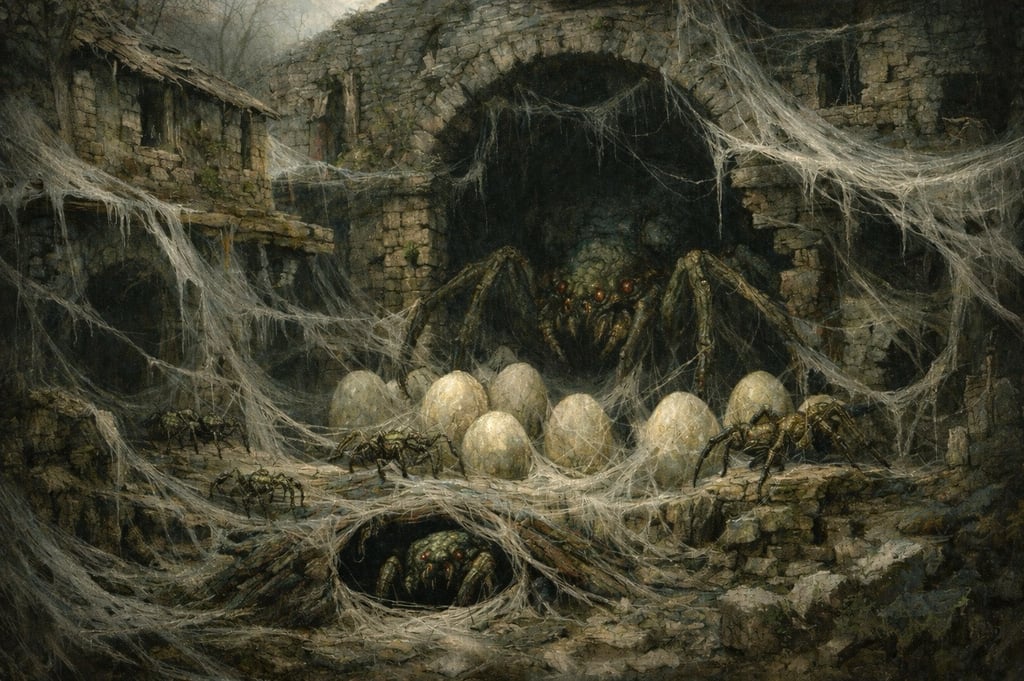
Atzul Spiders are a species of massive arachnids native to Anuheim, widely regarded as among the most dangerous non-sentient predators in the known world. Though regional names exist, all documented giant spiders belong to the Atzul species, with environmental specialization producing distinct ecotypes rather than separate species.
Adult Atzul typically range from three to five feet in leg span, with brood-defending individuals trending larger. Under rare conditions, broodmothers grow to colossal proportions exceeding ten feet in diameter, with the largest confirmed specimen measuring approximately twelve feet across.
Atzul inhabit forests, swamps, caves, ruins, deserts, frozen highlands, and deep underdark environments. They avoid open exposure, favoring concealed broodnests and ambush sites near prey routes. While most Atzul dwell deep within untamed regions, they occasionally establish hunting territories near roads and frontier settlements, particularly along Freeport’s forestward approaches, where they are considered a serious but manageable threat when discovered early.
Their significance lies not only in their lethality but in their influence on travel, settlement patterns, ecological balance, and material trade. Atzul silk, venom, and remains are valuable yet hazardous resources, and their presence shapes both fear and strategy wherever they dwell.
Classification and Shared Lineage
All giant spiders of Anuheim are classified under a single species designation commonly referred to as Atzul Spiders. This name persists because the forest-dwelling form is the most frequently encountered by scholars, rangers, merchants, and soldiers.
Local Names and Ecotypes
Regional naming reflects adaptation rather than taxonomy:
Atzul refers to the common name for and standard, most widespread ecotype, commonly found in forests, swamps, ruins, and temperate caverns.
Sarzun refers specifically to desert-adapted Atzul inhabiting arid wastelands.
Cryx refers to cold-adapted Atzul found in frozen mountains and arctic regions.
Klyss refers to an underdark cavernous Atzul adapted to deep subterranean environments.
These names were locally coined and later normalized by scholars.
Biological Unity
All Atzul ecotypes share identical foundational anatomy, reproductive capability, venom delivery systems, and predatory instincts. Differences arise solely from environmental pressures shaping behavior, physiology, and social structure.
Physical Characteristics
Standard adult Atzul range between three and five feet in leg span. Role within the population influences size: hunters, guardians, and defenders tend toward the upper range, while nest tenders and silk workers tend to be smaller. Females are consistently larger than males.
Broodmothers grow far larger due to sustained hormonal cycles tied to reproduction and hive coordination.
Exoskeleton and Markings
Atzul possess a dense chitinous exoskeleton with coloration naturally adapted to environment. While regional coloration will vary, typically Atzul spiders exhibit the following color adaptations:
Forest and swamp Atzul display mottled greens, browns, and blacks.
Sarzun exhibit sand-muted hues with light-diffusing surfaces.
Cryx develop frost-white or crystalline chitin.
Klyss lack pigment entirely, appearing pale, translucent, or stone-sheened.
Sensory Organs
Eight eyes provide low-light vision, motion detection, and thermal sensitivity. Fine sensory hairs along legs and abdomen detect vibration through ground, stone, web, and air currents, granting exceptional environmental awareness.
Fangs and Venom Apparatus
Serrated fangs deliver venom precisely. Venom composition varies by ecotype, but all forms are optimized for immobilization, preservation, or resource efficiency rather than rapid kill alone.
Life Cycle and Reproduction
The life cycle of an Atzul Spider reflects both conventional arachnid biology and significant divergence driven by brood-based survival. Their reproductive strategy emphasizes protected development, early role assessment, and aggressive resource control.
Egg Clutches and Early Development
Atzul broodmothers and sometimes other spiders lay clutches of unusually large eggs, each measuring approximately six to twelve inches in length. A single clutch typically contains several dozen eggs reflecting the substantial resource investment required for each offspring.
These eggs are guarded, maintained, and monitored within the broodnest by broodmothers and specialized broodtenders. Environmental stability, territorial control, and constant defense allow Atzul broods to expect a higher survival rate than most spider species.
Egg theft is rare and dangerous.
Spiderlings and Controlled Attrition
Upon hatching, spiderlings are immediately integrated into the brood structure. Unlike solitary arachnids, Atzul juveniles are raised collectively and protected during early development.
Cannibalism does occur, but it is selective rather than indiscriminate. Individuals deemed defective, weak, or poorly adapted may be culled by broodtenders or consumed by larger juveniles. This process serves as population regulation and early quality control rather than a primary food source.
Healthy spiderlings are actively shielded from aggressive brood members when necessary, ensuring that viable individuals reach maturity.
Growth Stages and Maturation
Atzul spiderlings grow rapidly, passing through successive molts as they increase in size, strength, and specialization. Full functional maturity is typically reached within a year, an accelerated timeline made possible by constant access to prey, protection, and brood resources.
As juveniles mature, they naturally differentiate into roles based on size and behavior. Smaller individuals tend toward silk production, nest maintenance, and brood care, while larger individuals become hunters, guards, or territorial defenders.
Atzul spiders grow stronger for many years reaching a peak maturity around 8 years.
Broodmothers and Reproductive Control
In brood-based ecotypes, broodmothers regulate reproduction through prolonged hormonal cycles. These hormones drive continuous growth, heightened aggression, and increased neural influence over nearby brood members.
Broodmothers and broodtenders maintain cohesion within the brood, suppress internal conflict during developmental phases, and coordinate expansion only when prey density allows.
When a broodmother dies, the neural cohesion that binds the brood dissolves immediately. Without that recognition, brood members no longer identify one another as friendly and enter a survival state marked by infighting, flight, and concealment, often devastating the hive before a new broodmother can emerge and reestablish cohesion.
Natural Mortality and Population Balance
Despite their resilience, Atzul populations remain constrained by brood warfare, environmental catastrophe, magical corruption, and targeted eradication by sentient races. While starvation is rare due to their ability to enter prolonged stillness, violent disruption remains the primary cause of brood failure.
This balance ensures that Atzul remain dominant predators without overwhelming their ecosystems.
Behavior and Intelligence
Atzul Spiders possess a level of intelligence that exceeds most non-sentient predators. While they lack abstract reasoning, they demonstrate consistent problem-solving ability, environmental memory, and tactical adaptation.
Hunting Strategies
Atzul favor ambush over pursuit. Their hunting methods emphasize patience, positioning, and inevitability. Rather than chase prey, they shape movement through layered traps, subtle pressure, and environmental manipulation.
Prey is often guided unknowingly into kill zones through web placement, vibration deterrence, and strategic withdrawal. Once engaged, strikes are fast, precise, and rarely repeated.
Territorial Behavior
Atzul territories are clearly defined by web presence and density. At the furthest stretches of their territory will be the most subtle lines of webs that notify when a presence has entered their territory. Broods maintain awareness of their borders and respond aggressively to intrusion.
Territorial defense escalates rapidly. Initial encounters involve probing attacks and trap activation. Continued intrusion triggers coordinated response from hunters and guards. There is no tolerance for sustained presence within an active territory.
Communication and Signals
Atzul communication operates through three distinct mechanisms, each serving a different function within the brood.
Broodmother Neural Influence: In brood-based ecotypes, the broodmother exerts direct neural influence over her brood. This connection binds them individually to the broodmother’s will. Through this influence, she directs coordinated action, suppresses internal conflict, and issues instinctual commands that brood members follow as if they were her own impulses.
Webway Vibration Communication: Atzul webs function as sensory and communication networks. Vibrations transmitted through silk convey location, movement, urgency, and disturbance. Brood members interpret these signals instinctively, allowing coordination across complex lairs without line of sight or sound.
Audible Signals: Sharp clicks, strums, and chitinous scrapes produced by fang articulation serve as immediate, localized communication. These sounds warn of threats, signal prey presence, or escalate aggression. To untrained listeners, the sounds are often indistinguishable from environmental noise.
The layered use of neural influence, webway vibration, and audible signaling allows Atzul to react with speed and precision, contributing to their reputation for sudden and seemingly inexplicable attacks.
Response to Threats
Atzul are aggressive but not reckless. When confronted by overwhelming force, they withdraw strategically, collapsing traps, abandoning outer territory, and retreating toward defensible positions.
They do not sacrifice brood integrity for territory. Survival and future viability take precedence over immediate dominance however they will defend their broodnest core to the death of themselves or the broodmother.
Web Structures and Lairs
Atzul silk engineering is a sophisticated natural construction. Webs are not static traps but dynamic systems designed to sense, communicate, and immobilize.
Web Types and Functional Design
Web architecture varies by environment:
Forest canopies: Layered snares suspended between trees, combined with vertical drop traps.
Ruins and caverns: Ground funnels, false floors, and corridor-spanning trip webs.
Deserts: Buried tunnel nets and collapse-triggered sinkholes reinforced with silk.
Frozen regions: Crystalline-reinforced webs that resist brittleness and ice shear.
Underdark: Sparse anchor webs used to suspend solitary hunters from ceilings or walls.
Each design reflects prey behavior and environmental constraints rather than aesthetic uniformity.
Lair Construction and Internal Structure
Lairs are multi-layered defensive environments rather than simple nests. Outer zones function as detection and attrition layers, while inner chambers house broodmothers, eggs, or solitary ambush points.
Brood lairs often include false passages, dead ends, and complex layered pathways intended to exhaust or isolate intruders before they reach critical areas.
Environmental Adaptation of Silk
Atzul silk adapts chemically and structurally to its environment. Variations in elasticity, tensile strength, adhesion, and mineral integration allow webs to function in humidity, heat, frost, and stone-dense spaces.
This adaptability is a key reason Atzul thrive across diverse biomes.
Signs of Occupation
Indicators of active Atzul presence include unnatural silence, absence of small wildlife, geometric web placement, disrupted terrain, and subtle vibration feedback when moving through affected areas.
Experienced travelers learn to recognize these signs quickly. Those who do not often vanish without trace.
Regional Ecotypes
Atzul spiders range across Anuheim in diverse and unique biomes.
Atzul (Standard Ecotype)
Found in forests, swamps, and most biomes, common Atzul form broodnests in concealed locations. They thrive particularly in dense forests such as Ebonhart Forest and swamps like the Tyrian Morass, where vertical space and prey density favor their tactics.
Sarzun (Desert Ecotype)
Sarzun Atzul are desert dwellers. They burrow beneath dunes and arid stone, using vibration sensing to ambush prey. Though often encountered alone, evidence confirms brood structures within canyon refuges, ancient runes, and even web structures that shape under-sand hollows.
Cryx (Frozen Ecotype)
Cryx Atzul inhabit arctic mountains and frozen wastes. They enter extended dormancy cycles, sometimes lasting decades in subzero temperatures. Their venom flash-freezes prey, preserving it for long-term sustenance.
Klyss (Underdark Ecotype)
Klyss Atzul dwell exclusively in the underdark. They lack pigment and possess pale, crystalline chitin that blends into stone and mud walls.
Unlike other ecotypes, Klyss are solitary. They do not form broods or queens. Females are significantly larger than males. Males wander the underdark seeking mates and frequently become prey for other creatures. After mating, females may consume the male for nutrients.
Breeding females construct temporary nests and become violently territorial until offspring emerge. No true brood hierarchy or queen structure has ever been observed among the Klyss.
Predators, Rivals, and Natural Checks
Atzul Spiders occupy a unique position within Anuheim’s ecosystems. An established brood functions as an apex predator within its immediate territory, exerting near-total control over prey movement and local wildlife behavior. However, this dominance is situational rather than absolute, limited by the brood’s fixed nesting behavior and lack of long-range migration.
Natural Predation
Atzul are not hunted as a preferred prey species, but anything significantly larger than an individual spider will consume them opportunistically. Dragons in particular are known to devastate broods when encountered, feeding on exposed hunters, guards, and even broodmothers if discovered. Against such threats, Atzul rely on concealment, retreat into layered nests, and rapid dispersal of non-essential individuals.
Sentient races, including goblins, wood elves, humans, and others, also hunt Atzul deliberately, though not as predators in an ecological sense. These hunts are motivated by material acquisition, threat removal, or survival rather than for material gain or as a food source.
Brood Conflict and Cannibalistic Warfare
The most significant natural check on Atzul populations is brood-on-brood conflict. Atzul do not compete for territory in a passive or negotiated manner. When two broods encroach upon one another’s effective range, conflict is immediate and absolute.
These encounters resemble all out war. Neither brood withdraws. Engagement continues until one broodmother is killed, at which point the surviving brood slaughters and consumes the defeated spiders entirely. The victor grows stronger and expands into the old brood's territory taking advantage of the labor of their enemy.
This behavior prevents dense brood clustering and ensures that only one brood dominates a viable hunting region at any given time.
Environmental Pressures
Atzul are remarkably resilient. They can enter extended states of stillness to conserve energy, making starvation exceedingly rare. Environmental collapse does affect them, but far later than it does prey species. As predators, they are often among the last organisms to suffer from ecosystem decline.
Their most consistent non-physical vulnerability is magical corruption. Warped magic, unstable rifts, or lingering arcane fallout can disrupt brood cohesion, sensory perception, and reproductive cycles, often resulting in brood failure or internal collapse.
Sentient Interference as a Limiting Factor
Removal efforts by sentient races act as a localized and temporary pressure rather than a true population check. Broods deep in the wild are rarely targeted. Most eradication occurs when individual Atzul or emerging broodmothers establish nests too close to settlements, roads, or trade corridors. These actions reduce immediate risk but do not meaningfully diminish Atzul presence across a region.
Relationship with Sentient Peoples
Across Anuheim, Atzul Spiders are universally recognized as predators rather than monsters in the mythic sense. They are feared not for malice, but for their efficiency, patience, and the quiet certainty with which they eliminate the careless.
Proximity and Avoidance
Settlements do not coexist with Atzul. Known brood territories are avoided entirely when possible. When avoidance fails and a brood establishes itself near a road, village, or frontier outpost, the response is swift and deliberate. Local forces, hired adventurers, or specialized hunters are dispatched to eliminate the threat before the brood can entrench itself.
Accepted danger zones are common. Merchants and locals learn when routes are no longer viable, adjusting travel paths long before an official response is organized. These adjustments are informal but widely understood, passed through rumor, loss reports, and sudden absences.
Strategic Indifference
Outside of immediate threat zones, Atzul are often left alone. Large, established broods deep within the wilds are not actively hunted. The cost of eradication is high, the risk severe, and the benefit marginal unless the brood obstructs movement or resource access.
As a result, Atzul frequently thrive in abandoned or lightly traveled regions, expanding their influence only when prey density allows.
Hunting and Exploitation
Adventurers actively hunt Atzul, motivated by the value of their materials and the likelihood that broods accumulate treasures from previous victims. Such hunts are dangerous but can be lucrative, contributing to the perception of Atzul as both threat and opportunity.
Organized powers, including Freeport, treat Atzul as hazards to be eliminated only when necessary. They are not pursued for extermination campaigns, nor are they tolerated within controlled territories.
Cultural Perception
Atzul feature prominently in cautionary tales and frontier folklore. They are invoked as examples of what happens when vigilance lapses, when roads are ignored, or when the wild is underestimated. Disappearances attributed to Atzul are often unresolved, reinforcing their reputation as silent killers rather than visible enemies.
They are not romanticized, worshiped, or misunderstood. They are simply known for what they are.
Use of Spider Materials
The Atzul species is valued not only as a dangerous predator but as a source of highly durable and versatile materials. Harvesting these materials directly from wild broods is extremely hazardous, as nests are aggressively defended and rarely fully cleared.
Spider Silk
Atzul silk is exceptionally strong, flexible, and resistant to wear. It is commonly used to produce clothing, rope, fishing line, and lightweight armor. In more advanced applications, the silk is woven into magical cloth armor due to its ability to hold enchantments without tearing or fraying.
Spider Venom
Atzul venom varies by ecotype but is consistently valuable. It is refined into paralytics, alchemical reagents, and weapon coatings. It is also used by some goblins as a form of hallucinogenic.
Carapace
The chitinous exoskeleton of Atzul spiders is thick, lightweight, and highly impact-resistant. Carapace is also widely used for tools, helm reinforcements, and protective fittings due to its durability and natural resistance to corrosion.
Spider Fangs
Atzul fangs are both trophies and functional materials. Their natural serration and strength make them ideal for crafting blades, spear tips, and hooked weapons. Among goblins, fangs are often used as daggers.
Spider Meat
Atzul spider meat is technically edible. When properly cooked and treated to neutralize residual toxins, it provides a dense, protein-rich food source. Common for adventurers and primitive species like goblins and trolls.
Spider Eggs
Atzul spider eggs are used by goblins to domesticate spiders for labor, hunting support, or breeding. Spider eggs are technically edible and provide dense nutrition when cooked, though they are widely regarded as an inferior food source.
Although harvesting Atzul materials from the wild carries immense risk, goblins across Anuheim are known to tame, manage, and work alongside Atzul spiders. These arrangements provide a consistent and reliable source of silk, venom, carapace, fangs, and meat. Compared to entering an active broodnest, acquiring materials by raiding goblin settlements is considered far safer.
Lore
Explore rich lore from the fantasy setting on Anuheim
Adventure
Quest
Jackisath@Gmail.com
© 2026. All rights reserved. Created by Nectagrity