
The Evareach Mountains
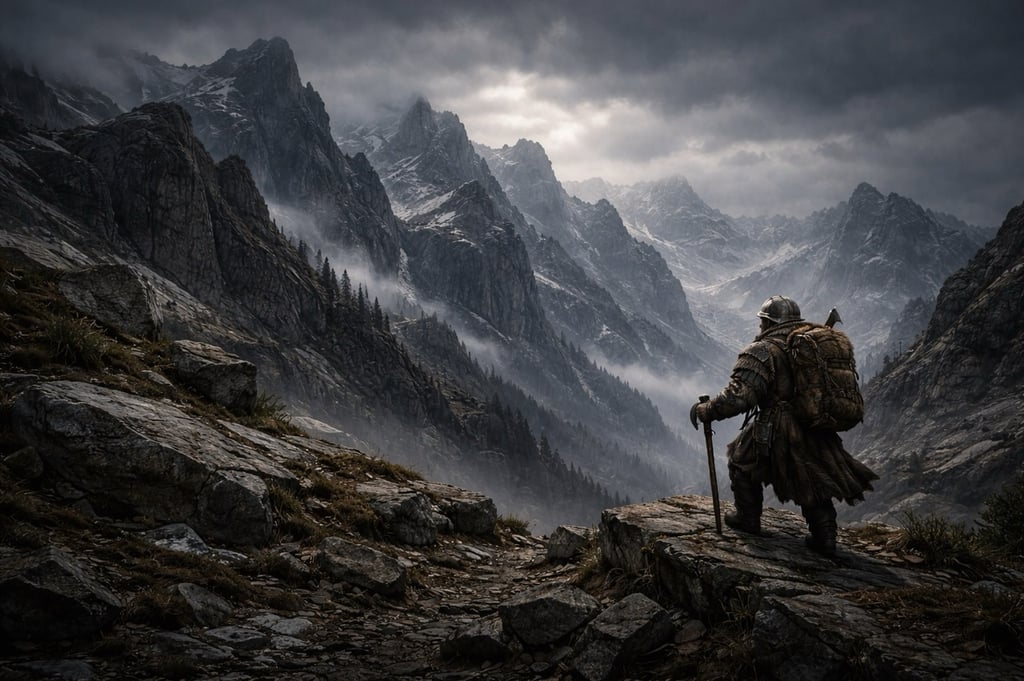
A harsh mountain range marked by dwarven kingdoms, deadly passes, rifts, dragons, goblin clans, and the scars left by the Demonlord of Wrath.
Jack Isath
The Evareach Mountains rise in a vast east to west spine that holds back the Ebonhart on one face and leans into high desert on the other. Peaks climb into permanent snow. Valleys open to brief, lush summers and close again under long snowy winters. The range narrows to the east where it breaks into stepped canyons that quickly descend toward the sea, then thickens westward into a maze of rolling mountains and shadowed valleys.
The stone remembers war. In the Demonic Wars, the demonlord of Wrath, Vorrak, tore a gouge through these heights and hurled the Ashen River from its northern and eastern course to flood southward into the lands that we know as the Tyrian Morass today. That wound still patterns the waters and the tempers of those who live here.
The southern foothills of the mountains press against Freeport’s frontier and the Ebonhart Forest’s advance. The northern foothills roll into a high, dry desert known as the Ashen Desert. The Evareach Mountain routes remain poorly mapped. The few charts one can buy are copied at Westhart Haven.
Boundaries, Rivers, and the Wound of Wrath
In the old flow the Ashen River ran north and west through a high desert that could bear orchards along its banks. When Vorrak split the stone, the river heeled over and fell south. It now joins the Westhart River delta in the low countries and feeds the Tyrian Morass instead of the desert.
The path of that calamity remains a dead ravine of vitrified rock and glassy obsidian shelves. Warlocks who court that dominion gather in hiding along its rim to drink from echoes of magic they do not understand.
The Westhart, formed deep within the Ebonhart Forest, is filled by tributaries falling out of the mountains before it spreads out into the Tyrian Morass. Along one open bend stands the only place Freeport can plausibly name as its own line in the Evareach. That is where the town of Westhart Haven rests.
Westhart Haven
Westhart Haven is a working village built on the southern bank of the Westhart where the current permits a stable ferry. The place began as a watchtower and a rope spool with a skiff. It grew into planked streets on pilings, smokehouses, a barge yard, and a ferry quay that never sleeps in good weather. The tower still stands. Its signaling mirrors throw sun back into the trees by day, and its beacon burns on nights when the road must be warned.
Dwarves from the mountains trade here more than anywhere else south of their gates. They bring bars of iron, selected ores, cut stone, and small lots of myric shards. Gnomes with a taste for air and arguments live among the humans in a few narrow streets of tiled roofs. They are engineers, Shardwrights, and curious adventurers. The Haven keeps the only reliable stock of maps.
Westhart Haven is a sizable town with some influence in Freeport as a point of commerce and trade. The town is managed by the Fenmar noble family who, having failed in the defense of the Freeport lands once before, have been more or less ostracized to this town away from the influence and wealth of Freeport.
Approaches and Roads
The Evareach Pass Road begins at the ferry landing in Westhart Haven and runs clean for a day on well maintained paving where the land permits. After that, the road begins its climb through switchbacks coming to the first of two major passes, the Pass of Nidarun. Marked by a fortification, a gate where the road divides. One road turns towards closed gates that belong to the dwarves. The other climbs to the pass and over the first real challenge of the journey.
Along the road there are two true passes and a dozen false summits. Most side routes end in broken ledges, collapse into goblin holes, or lead to shallow caves where greater monsters live. In summer the road is barely passable without escort and luck. In winter it is closed by a roof of thick and dangerous snow.
Irongate, an outpost stationed along a false-summit pass protects the way from unwanted travelers. This outpost keeps the road safer than expected from ambush and raid alike. However, a bypass has been made wide enough for a cart to go around the fortification. It is made of tire-scored dirt and sharp stones and exposes travelers to steep falls and loose rock. The dwarves keep an eye on this route as well to the unknowing bypassers.
The Gate-Hall and the Underway
The other fork at the pass leads inward to a massive gate inside a cliff face carved with scenes of trade and peace. The place is a dwarven hall. Room after room shows a deft hand in the
stone. Stalls cut into the wall sell worked metal, resin lamps, chisels, shards, gear that travels well, and armor hard as the rock it rests on. Statues dot the hall’s floor of collaboration among the many races and great merchants of the dwarves. Balconies look over the hall but cannot be reached. Their access is sealed behind a second gate and a guard post just big enough for a fully loaded wagon to roll through.
Behind that smaller gate the dwarves keep a small town of their own with sleeping quarters, shrines, a clinic, and ovens. Chimneys from those ovens pierce the slope above and breathe under the snow. Here a massive tavern serves dwarves and respected travelers alike.
Beyond a third and final gate, just tall enough for a small cart but built like a vault door, the hall opens to a rail-line laid on steel shoes and bedded in crushed gravel. The carts are chained and braked and coupled by hand. They run by a device of gnomish design bolted into the spine of the train and powered by cut myric shards.
Two tracks run side by side. One for each direction. The dwarves call this the Underway. It is the artery through which Nidarun’s wealth travels.
Permission to ride the Underway is not bought. It is earned. Caravans of long standing, envoys of remembered favor, and the few whose names have weight in the hall are allowed aboard when the gate sergeant approves the manifest. However, this system is typically used only to transport dwarves and goods to their underground city.
The Kingdom of Nidarun
Nidarun is not a single chamber with a high chair. It is a linked crown of chambers, shafts, and galleries that hug the heart of the mountain. The work shows the hands of centuries. Pillars rise from the bedrock. Floors are flaked and polished by generations of boots. Water is caught, claimed, and used to turn great wheels for industry. Heat is harnessed in the smithies. The city’s breath leaves through a hundred chimneys disguised as boulders and light wells.
Above the halls lies a secret valley the dwarves call the Crown of Nidarun. It is a boxed-in valley of pasture and rock gardens hemmed by cliffs and watched by towers cut to look like broken stone. Goats feed there and learn to climb for sport. Smiths who need air keep shops in stone sheds.
The valley’s center is a fortress built square around the tunnel to the city. It is the first gate in war and the last gate in panic. Many dwarves who choose a surface life begin here. They learn of weather. They learn the noise of ice that moves in the night. They learn why the outposts are always manned.
Dwarven Outposts
The outposts are single-build halls with a wall and a gate and a tower that always watches. Beneath the hall lie rooms enough for fifty but only a third of that number live in each station in ordinary times. There is an armory, a food store, a water room, and a tavern in the center. The stone lip around the roof makes a narrow walk with windows cut for archers and for the spyglasses that look for threats but more often read the weather.
Above the main passage to the Crown of Nidarun, the greatest of these stations, Irongate, holds the count of travelers. The dwarves here do not sneer at tallfolk. They record and send news. Like all outposts, they keep mountain eagles in an aviary in the watchtower and can reach the Crown in a single flight. The gate they guard that leads to the crown valley stays shut. The other two through-gates at the pass remain open to keep trade moving but are never left unguarded.
Irongate sits where the Evareach Pass Road crosses between the two major passes. It sits on a false summit with three gates and two great walls. The dwarves on watch let travelers pass through and often invite them for reprieve after their long and difficult travels. Here travelers are safe for a small price and they can even dine and drink in warm taverns filled with song and dance.
The third gate leads into the mountain side, a tunnel dug deep, a road that exits into the valley above Nidarun.
The Northern Slope and Descent
On the north side of the range the land unrolls into high benches that hold grass in the wet. Beyond those benches lies the Ashen Desert. It is not all dead. In the right month it bears green in hollows and thin streams along its old riverbed where the mountain's tributaries still trickle. People live here because they always have and because their grandparents refused to leave even when the weather and land changed.
Their largest town is named Descent. The Evareach Pass Road drops into it and then drops again into the lean land beyond. Descent is the market for hides, low-quality metals, and rough shards that the foothill folk wrestle from their hills. The town is rimmed with shoddy wooden walls for protection. Outsiders are tolerated because the town’s survival depends on goods that come from elsewhere.
Trust is offered slowly. Opinion of Freeport is cold at best. In winter, the town of Descent braces for raids by Frozentooth Barbarians and Grimgobs, and for the plain hardship of surviving the cold season.
Peoples of the High Country
The mountain folk of the Evareach are a mixed line of settlers, exiles, and stubborn families who refused to move or live elsewhere. They farm narrow mesas. They run goats and sheep. They mine where a seam breaks daylight and stops again three feet later. Their dead are placed in wind-cut tombs above the town and sealed shut. They place curses on the tombs: any who open them will face the wrath of their ancestors. Tombs can hold anywhere from a family to whole villages before they are sealed shut in this manner.
The Frozentooth Barbarians are not of the northern slope foothills. They live in the high valleys where mammoths walk and frost trolls wander. Their leather is thick and fur-lined. Their weapons are hard wood set with stone or heavy iron taken as loot. They follow the herds with the weather. In winter they come down and take what they need from villages on either face of the range.
They are not mindless. If a village fights back with tenacity, the Frozentooth make a note and walk past the next season. They prefer to win with fear and ceremony. When the young are hungry they forget their elders’ cautions.
The Evareach Depths
Deep under the dwarves’ home and mines lie gnomes. Their city in the Evareach Depths is an engineered hive with law, patrols, and one great civic hunger for devices that work. They rarely come to the surface. They trade with Nidarun through sealed manifests and guarded handovers. It’s not that the Evareach gnomes distrust the dwarves, it’s that the monsters of the underworld are immense and extremely deadly.
Not much is known about the underworld except that great monsters lurk in the dark and gnomes tinker with otherworldly devices and that their prowess cannot be measured by their stature. They have created not just security in the depths, but civilization.
They have access to the surface through various cave systems that mostly egress in the Ebonhart Forest. They barter with Nidarun dwarves for access through their mines if they desire to surface in the Evareach Mountains. The depths occasionally birth a horror so great that whole mine shafts will purposefully be collapsed in on themselves, sealing the monster into the depths. Gnomes will explode and collapse passageways if necessary but this is unpredictable and a less than desired option.
The Depths connect to other underworlds in theory, yet in practice the routes are too narrow or too dangerous for regular traffic. The gnomes are content with their order and their partnerships.
Goblins of Stone and Gold
The Grimgobs
Grimgobs are mountain goblins. They stand a head taller than their forest kin and carry weight as if born to it. Their skin is as hard as reinforced leather and bony growths under the skin harden into irregular plates across their shoulders and head. They like the sun when it finds them and a dry cave when it does not. They migrate up and down with the seasons and consider the habit wise. They fight each other over nothing. They fight outsiders over everything. And they fight for anything.
Grimgobs dig into caves and break rock with their primitive tools. Breakthroughs into dwarven homes and mines are frequent. The goblins call it right of challenge and flood a shallow dwarven warren with bodies until a line of fire and steel pushes them back. In summer they build shacks that last the season. In winter they gather in the first caves they can find or abandoned dwarven homes they’ve destroyed.
The Krurt
The Krurt are a different cut of goblin that branched off from their mountain cousins with a strain of unusual intelligence. Their hall is a hollowed cave with a treasure chamber at the core called Gnibkezz. They hire the most brutal of their kind to guard their hoard.
They keep ledgers that list goblin tribes who owe them gold and they hold those tribes to their word. They buy the strength of the strongest goblins and hire them to kill other goblins. They run the goblin economy across mountain and forest lines and are the cause for so much in-fighting that occurs within the goblin race.
The Silent Monastery
High in the peaks stands a monastery of stone and snow that Freeport maps mark as The Silent Monastery. It is older than any record or history book can prove. The monks take vows that do not break and they no longer speak.
They sit in the cold and attend to breath. They carry water from far springs and train the body until it is a tool for the mind. They shelter travelers in storms and turn away armed men who look to claim the place. And a mysterious Holy-Light power prevents would-be conquerors from entering.
The monastery endures on the support of the faithful who live in Freeport. Mules bring sacks of grain and rolls of wool in the months when the road is passable. Some say they guard a secret that is not a weapon but a holy practice. Others say their secret is that there is no secret.
Arcane Rifts and the Veilbreak
The Evareach attracts rifts to tear open. Some show as spinning motes of glassy light that hum against the teeth. Others are wounds you can see cut through open air. Rifts here twist magic, break time out of order, and throw reflections that step before their owners. Known hazards include a gorge of living mirrors, aptly named the Maw of Mirrors, where everywhere you look appears a reflection of yourself and not the land around you. Many get lost and die here from starvation as they go mad.
The Veilbreak Covenant keeps a timbered town high on a ridge, named Veilbreak Lodge, with walls and magical wards against raiders. Aetherforged walk their palisade with the measured hunger of those who breathe arcane vapor more easily than clean air. Expeditions venture out in every season and weather using magic to create safer travel over the harsh mountain passageways. The Veilbreak harvests powerful arcane magic in the Evareach range.
The Covenant closes rifts after it has taken its due. In this the dwarves and locals tolerate them but do not trust them within their own halls but neither do the Covenant ask for any hospitality. The Veilbreak Covenant fight and destroy any creatures that come between them and the arcane rifts here with fervent resolve.
Creatures of the Evareach
RaThon, White of the Highest
There lives in rumor and in the careful speech of shepherds a white dragon whose name is RaThon. Those who swear by him say he sleeps where the wind is a blade and wakes when the mountain shakes. A splinter of Grimgobs worships at caves near his suspected lair. They bring meat and polished bones.
White drakes and young dragons wander and hunt throughout the Evareach Peaks. They keep to the rock and the pale light. The white dragons have been recovering fast in the century post Demonic Wars. They have spread now to every area in the mountains and it’s believed they are all the offspring of RaThon.
The Valley of Stillness is said to have been created by RaThon by every storyteller and bard to travel the way. It is a trough in the stone where the wind never moves. An army stands there like statues behind glassy ice. Faces still look out from the ice with a fear that did not end. Whether it was breath or spell or both that caught them is not known.
Stone Titans
The stone titans are giant beings, standing nearly twenty feet tall, their bodies carved from the same granite that shapes the mountains they inhabit. To the untrained eye, they appear no different from jagged cliffs or weathered boulders. Lichen clings to their skin, moss fills the cracks of their joints, and snow gathers along their shoulders, masking their form so completely that even seasoned travelers might pass them without notice.
They slumber for decades, sometimes centuries, as if the mountain itself were breathing slowly through them. When disturbed, they awaken with a grinding roar of stone splitting from stone, their movements shaking the earth beneath them. In their waking rage, they are relentless. Yet their fury is not endless. Once the fire of their anger cools, the titans return to stillness, sinking back into the mountain until they are indistinguishable once again.
Cryx Spiders
The Cryx are Atzul giant spiders and akin to the desert Sarzun. Their bodies are shaped like angles of white edged in crystalline frost. They can lie in wait for decades when the cold holds strong. When a warm body steps onto their web or puts weight into a drift above them, they wake and pounce. Caves with hot springs are a favored ground. There the spiders can hunt every day instead of waiting for prey. Traces of their presence disappear under new snow within minutes.
Mountain Trolls
Mountain trolls stand between eight and twelve feet tall, their hulking frames shaped by years of climbing jagged ridges and dwelling in high caverns. Their skin is tough and leathery, often colored like the dust and stone of their surroundings. Though brutish and dull-minded, they are dangerously quick to anger and deceptively fast for their size.
Typically solitary, a mountain troll stakes out a cave as its home, filling it with the crude spoils of scavenging and theft. They roam the slopes with the seasons and weather, always seeking drier, warmer ground. When encountered, their blend of raw strength and unpredictable temper makes them a constant hazard.
Frost Trolls
Frost trolls are close kin to their mountain cousins, but shaped by the bitter winds and endless ice of the high peaks. Their bodies are cloaked in coarse, matted fur that shields them from the cold, and their skin is paler, with a bluish hue. They lurk in frozen caves and glaciers, where their presence is marked by shattered bones and half-buried remains. Nearly identical in size and temperament to mountain trolls, frost trolls are no less reckless or violent, but the cold seems to sharpen their endurance, making them tireless hunters in their frozen domain.
Frost Bats
Frost bats are small, predatory creatures with wingspans of about a foot, their bodies cloaked in pale, icy fur that blends with snow and frost. They swarm in colonies within frozen caves and
crevices, emerging at dusk to hunt. Their bite delivers more than pain: a numbing chill seeps instantly into flesh, freezing muscle and locking prey in place while the bat feeds. Though their favorite prey are the goblins of the high passes, they are bold enough to attack trolls if they can find a patch of unprotected flesh. Alone, they are little more than a nuisance, but in numbers they become a nightmare.
Great Herds of Eastern Valleys
Mammoths walk the eastern heights in the rolling valleys that widen with every decade. Goats pick their way along ledges, mountain lions stalk their prey, and bears follow the herds preparing for the deep winters. When the summer breaks the snow off the high bowls, elk and deer push into the green to graze the new growth. In these same months beavers work the lower streams building their dams creating new ponds and ecosystems for all to enjoy.
Resources and Trade
The Evareach Mountains hold iron and gold in deep veins. Myric shards grow along lines that run like old roots through the stone. Dwarves keep the largest claim as the greatest of miners. The best shards make their way to the gnomes in the underworld. Others go to Freeport and to distant lands. Humans in the northern mesas mine what they can and trade when they must. They keep the best materials for their own tools.
The Veilbreak Covenant are responsible for a large amount of exports with their shards of arcane magic making its way by cartload to Westhart Haven where it’s worked by a small group of Shardwrights and Aethersmiths stationed there combining the metals of the dwarves with their own magic has allowed the Veilbreak to grow an efficient business in the region.
Even the goblins get in on the trade but they do so along their own routes into the Ebonhart Forest into Sylvanfall which is the greatest of all goblin bazaars.
Trade is the reason any of these roads exist. Without it the Evareach would shut their doors and let snow write silence over the cuts.
Weather, Season, and the Shape of Travel
Summer in the Evareach is short and noisy. Streams from springs and snowmelt pour and cut paths through the mountains. Valley floors grow grass deep enough to hide a grazing elk. Wildflowers spot the slopes. Ducks find lakes that did not exist the year before and flee when the bats return with the snow.
All of this lasts long enough for travelers to be fooled into thinking the mountains are an abundant heaven that will provide them with resources year round.
Winter shows the truth. The passes close with snowfall accumulation. In these months only the Underway moves with certainty and only because the line is sealed and the walls are thick. The outposts of Nidarun run a skeleton crew locked away all winter in their post. The mountains are done giving and the residents that remain must make do with what they have until the warmth returns in spring.
The Mysterious Barrow
There is a barrow in the Evareach whose mouth glows faint on cold nights. The stones around it are cut with glyphs in a hand that repeats. A book found nearby long ago tells a tale of a mage who held death in his fist and put souls to work as locks.
After decades of study, many scholars and would-be mage explorers have taken note and passed on the book: They say he is buried inside or perhaps he is a lich who sealed himself to study in silence or that perhaps the whole thing is a fraud.
Locals walk a different way when their trail would pass within sight of that glow.
Lore
Explore rich lore from the fantasy setting on Anuheim
Adventure
Quest
Jackisath@Gmail.com
© 2026. All rights reserved. Created by Nectagrity