
The Goblins of Anuheim
An in-depth overview of Anuheim’s goblins, detailing Skragglin, Murklin, Grimgobs, and Krurt culture, survival, and their god Alk.
Jack Isath
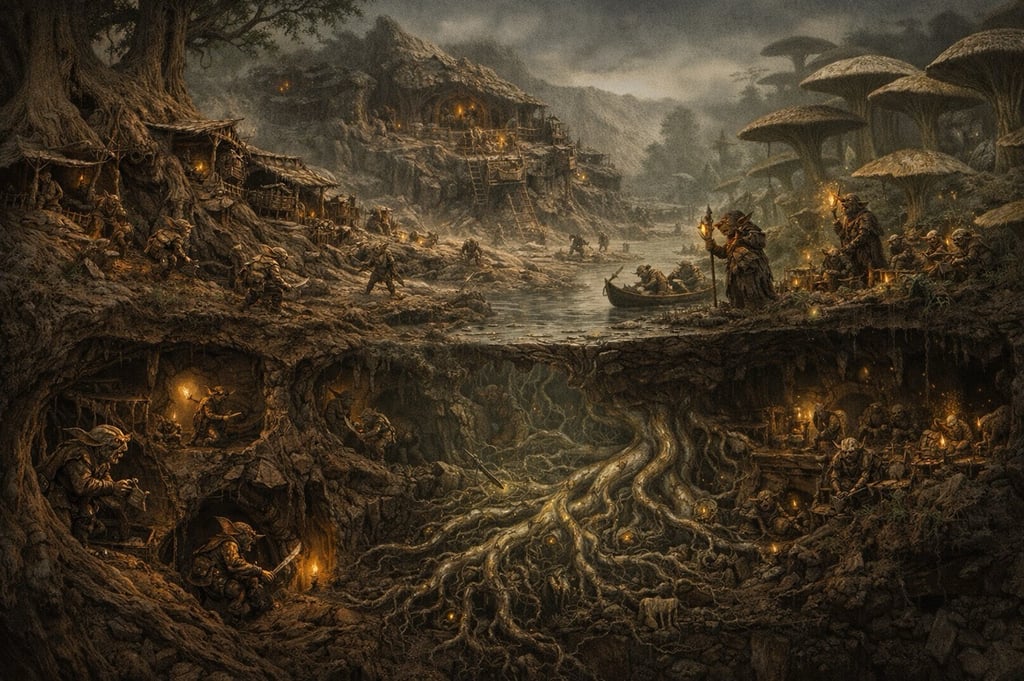
The goblins of Anuheim form a broad family of small, aggressive humanoids adapted to four primary environments across the western regions: deep forest, swamp, high mountains, and the underground trade corridors that connect them. While they share a common scavenger economy and a raiding-centered way of life, goblins rarely function as a unified people. Power is held through tribe, territory, and access to resources, with shifting alliances sustained by intimidation, debt, and opportunistic violence.
Goblin societies in this region are commonly described through four major factions:
Skragglin
Murklin
Grimgobs
Krurt
Shared Characteristics
Goblin social life is organized around tribes, warbands, and strongholds. Leadership typically centers on the strongest and most feared individuals, supported by specialists who control high-value functions such as warlords & champions, shamans, craftsman (alchemists, smiths, bowyer, etc), spider-breeders, or merchants.
Tribal cohesion is functional rather than sentimental. Goblins maintain unity when it increases survival, raiding success, or control of a resource. Splintering occurs frequently when leadership weakens, resources shrink, or debts become unmanageable.
Economy and subsistence
Goblins maintain a mixed survival economy that combines:
Hunting and gathering (small game, fish, edible fungi, roots, eggs, insects)
Harvesting and processing (mushroom products, venom, silk, hides, crude lumber)
Raiding (ambush of roads, ferries, river craft, outlying farms, rival goblin bands)
Scavenging (salvage of battlefields, ruins, abandoned structures, shipwrecks, and caravans)
Raiding parties are typically opportunistic. Targets are chosen for vulnerability and accessibility rather than long-range strategy. Successful warbands return with finished goods that improve survivability and tribal status: salt, weapons, arrows, armor pieces, lanterns, medical supplies, and other materials the goblins cannot craft.
Weapons and metallurgy
Goblin smithing technology reaches bronze-level capability at best, with crude mining focused on accessible deposits such as copper, tin, and shallow silver. Refinement remains inconsistent, and large-scale production of high-quality metalwork stays limited.
As a result, goblins commonly fight with whatever can be obtained, including:
stone, bone, and wood weapons
bronze tools and blades of uneven quality
stolen iron and steel weapons captured from other races
scavenged armor pieces worn as patchwork
In practice, goblin warbands often include a mix of crude weapons and isolated high-quality pieces treated as trophies, status tools, or reserved arms for leaders and enforcers.
Resource extraction and landscape impact
Goblins extract resources aggressively and with minimal long-term stewardship. Wildlife is exceptionally reduced in areas that goblins have established settlements.
In forest regions this includes clear cutting for lumber, palisades, scaffolding, smoke-halls, and warren reinforcement. In swamp regions it includes intensive harvesting of fungi, spores, reeds, and amber. In mountains it includes crude mining, stone breaking, and stripping herbs from high slopes.
Skragglin Forest Goblins
The Skragglin are forest goblins centered in the Ebonhart Forest. They are considered the largest goblin population in the region and the most territorially entrenched, holding long-term tunnel networks, warren systems, and ambush corridors.
Sylvanfall and goblin governance
Skragglin power concentrates within Sylvanfall, the only Great Tree controlled by the goblins of Ebonhart Forest. Sylvanfall functions as a combined fortress, settlement complex, and political center. Its interior is a layered structure of root-warrens, tunnel halls, trap corridors, and brood chambers.
Within Sylvanfall, governance is dominated by six major tribes, each holding status through specialization:
Esyrk (largest military presence; dominant influence through numbers)
Ravenarrow (assassins, scouts, contract killers)
Jaagkal (Atzul spider breeders; venom and silk economy)
Brak (builders and trap-makers; structural warfare and mechanisms)
Hightower (enforcers, heavy raiders, slavers)
Ebonspear (border raiders; noted for stolen arms and road ambush)
These tribes maintain a functional balance through rivalry and mutual dependence. Alliances form around raids, debt payments, and retaliation cycles. Power shifts frequently through assassination, coup, and opportunistic elevation of strong war leaders.
Settlements and defenses
Outside Sylvanfall, Skragglin settlements appear as:
Tunnel warrens dug into root-webs and low hills
Mud-walled villages with smoke-halls and grog pits
Scaffold platforms tied to trees for lookouts and ambush staging
Spider pens and venom pits near breeding sites
Skragglin defenses emphasize terrain control and trap architecture. Approaches are shaped into choke points, with concealed pits, spiked gates, trip lines, poison smears, and dead-end tunnels designed to separate and kill intruders quickly.
Economy
Skragglin commerce centers on high-value forest outputs:
Atzul venom, silk, and eggs
Fungal products and intoxicants
Lumber from clear-cut zones
Stolen weapons and armor
Mushrooms, moss, meat, and herbs
Their raiding focuses on roads, forest-edge farms, supply wagons, and isolated patrols. They also raid rival goblin tribes when weakness presents itself, particularly when debts or leadership transitions create openings.
Murklin Swamp Goblins
The Murklin are swamp goblins occupying the Tyrian Morass and related swamp biomes. They are broadly similar to forest goblins in behavior and tribal structure, while displaying a stronger cultural identity around fungal disease, swamp survival, and shamanic authority.
Murklin are typically shorter than forest goblins by a few inches, more visibly varied in color with stripes and swirls, and culturally shaped by permanent exposure to spore clouds, stagnant water, and fungal growth.
Settlements
Murklin settlements concentrate in the mushroom forests and temporary camps in the wetland corridors of the Morass. Common structures include:
Dwellings carved into massive fungus stalks
Reed-and-bone huts built on stilts over waterlogged ground
Hanging shelters suspended beneath broad mushroom caps
Canoe racks and mud docks enabling rapid water movement
Major Murklin strongholds include Murkore and Murlim, both established within dense fungal territory and reinforced through spore defenses and warband patrol patterns.
Mushroom economy and intentional harvesting
Murklin harvesting practices focus heavily on mushrooms as a foundational resource. Mushrooms serve as:
A staple food
Brewing material for grog and spore liquor
Poison base for darts and blades
Dye and tanning compounds
Ritual substances for shamanic rites
Murklin warbands often include harvest specialists whose role is to gather specific mushroom types, amber fragments, reeds, and medicinal swamp plants during hunting parties, raiding warbands, and scouting patrols.
Bralm and shamanic authority
Murklin maintain the strongest cultural connection to bralm, a goblin shamanic tradition rooted in fungal sorcery, spore manipulation, and the power of amber found in swamp environments. The Murklin affinity for bralm is closely tied to Murklic Amber, which functions as a valued magical catalyst and status resource.
Bralm is used for battlefield concealment, fear rites, sickness crafting, and shamanic initiation. Shaman leaders commonly function as both religious authorities and tactical commanders, with influence shaped by survival through dangerous rites and by control of rare spore resources.
Warfare and raiding pattern
Murklin warfare relies on:
Canoe raids on waterways
Ambush from foggy corridors and reed beds
Poison delivery through darts, blowpipes, and smeared blades
Spore-based concealment and intimidation
Their raids often target river merchant traffic, isolated shoreline camps, and swamp-edge settlements. Inter-tribal Murklin conflict remains common while raids on other races such as humans are more rare. These conflicts are driven by resource scarcity, shaman disputes, and control of amber harvesting grounds.
Grimgobs Mountain Goblins
The Grimgobs are mountain goblins of the Evareach mountain range, surrounding highlands, and other mountainous regions. They are physically heavier than many forest and swamp goblins, with hardened skin and bony growths that form natural armor-like ridges across their shoulders, thighs, and head.
Grimgob culture centers on mobility, seasonal survival, and brute dominance. Their tribes migrate with weather, moving between caves, ridges, and foothill corridors as snow and prey shift. Very few long-term settlements exists which still experience seasonal population fluctuations.
Tribal organization
Grimgobs typically live in small tribal bands, commonly ranging from a dozen to a couple hundred individuals. A limited number of larger villages exist where terrain supports stable shelter, mine access, and defensible chokepoints.
Leadership is direct and violence-driven, with authority concentrated in chiefs who can hold followers together through fear, food, and success in raids.
Blackdig
The largest Grimgob foothill settlement is Blackdig, a network of caves, crude mines, and scaffold structures built into the foothills leading toward the Ebonhart Forest. Blackdig functions as a staging ground for raids, a storage site for ore and stolen goods, and a tribal meeting space for larger warband assemblies.
Blackdig is the heart of trade among the Grimgobs and has a road that leads directly to Sylvanfall in the Ebonhart Forest. While few know it, this settlement has an underground route that leads to Gnibkezz.
Mining and valued resources
Grimgobs mine crudely, focusing on accessible seams and shallow deposits. They also gather and raid each other and other races for materials. Their most valued materials include:
Obsidian used for blades, points, and trade
Mountain herbs used for crude medicine, poisons, and brewing
Copper and tin as well as any other metals they can figure out how to identify or find
Stolen goods, especially weapons and food
Conflict pattern
Grimgobs raid mountain passes, foothill villages, and travelers moving between regions. They also break into rival holdings, including captured structures and abandoned sites that become winter shelters. Their conflict with other goblins increases when Krurt debt enforcement pushes them into raids meant to pay tribute.
Krurt Cunning Goblins
The Krurt are a hobgoblin-sized faction, physically comparable to the larger goblins of the mountains. They form the smallest population among the major factions while controlling the widest commercial influence.
Krurt power centers on the underground city of Gnibkezz. From this hub, they manage the goblin economy through debt, tribute, and enforcement contracts that affect tribes across the northern are of Ebonhart Forest, the eastern edge of Tyrian Morass, and the entire southern expand of the Evareach mountains.
While tribes outside of this region exist, they are beyond the Krurt influence and also living in less than ideal conditions for goblins due to increases hostile pressure from greater civilizations, lack of trade between fellow goblins, and access to abundant natural resources which the Krurt have cultivated in this region.
Political economy
The Krurt operate through a system resembling unregulated and rudimentary banking combined with protection rackets. Their influence is built on:
Ledgers that often change recording debts owed by tribes and leaders
Tribute framed as “protection” payments
Control of high-risk commerce, including drugs and other seedy services
Purchase of brute-force enforcement through hired killers and elite warbands
Redistribution that favors compliant tribes and destabilizes rivals
Krurt influence is commonly indirect. They maintain power by strengthening intermediary gangs who collect tribute locally, allowing Krurt leadership to remain distant from day-to-day tribal conflict. When a tribe fails to pay, enforcement appears in the form of sudden raids, assassinations, or the funding of rival claimants.
Governance and culture
Krurt society is hierarchical, driven by status and accumulation. Their internal culture rewards cunning and intimidation, while leadership remains unstable due to constant power struggles and opportunistic coups with ledgers being the only consistency. Ritual life centers on demonstrations of dominance, wealth display, and the reinforcement of internal rank.
Role in goblin instability
Krurt control functions as a pressure system within goblin society. By extracting wealth and purchasing violence, they amplify infighting between tribes, fuel leadership turnover, and increase the pace of raids. The resulting instability helps prevent any single goblin faction from consolidating lasting empire outside Krurt influence.
Alk, The Mushroom God
Alk is the primary deity recognized by goblin societies across Anuheim. Unlike many deities worshiped by other cultures, Alk is understood to be a physical, immanent entity rather than a distant or symbolic figure. Goblin belief holds that Alk exists as a vast subterranean fungal network extending through soil, stone, roots, organic remains, and abandoned structures beneath the surface of the world.
Alk is associated with decay, reclamation, persistence, and renewal. Its presence is believed to expand wherever organic matter decomposes and where environments have been abandoned or rendered uninhabitable by other peoples.
Physical Nature
Alk does not possess a singular body or centralized location. Goblin tradition describes Alk as a distributed organism composed of interconnected fungal growths. These growths spread through natural and artificial underground spaces, including caves, warrens, burial sites, ruins, and former settlements.
Alk is typically invisible on the surface because its primary domain lies beneath the ground, only surfacing as mushroom growth. Goblin societies regard this subsurface existence as intrinsic to Alk’s function and influence.
Origin of Goblins
Goblin origin traditions attribute the emergence of goblinkind directly to Alk. According to this belief, goblins formed from accumulated decaying matter including organic remains, ruined tools, collapsed structures, and exhausted soil. This material was reshaped over time through Alk’s fungal processes into living beings.
This origin is described as growth rather than creation. Goblins consider themselves a natural product of environmental reclamation, shaped by decay rather than crafted through deliberate design. As a result, goblin physiology and behavior are understood to reflect adaptability to instability, confinement, scarcity, and environments abandoned by other species.
The Living Covenant
Goblin societies maintain a reciprocal relationship with Alk. This relationship is not expressed primarily through prayer or doctrine, but through cultural practices that sustain fungal growth and decomposition. Common practices include the burial of remains within fungal chambers, composting of waste, maintenance of spore gardens, and ritual cultivation of edible and alchemical fungi.
Consumption of Alk-associated fungi is widespread and culturally significant. Goblins believe this practice reinforces instinctual behavior, social cohesion, and alignment with communal survival priorities. The effects of this consumption are treated as experiential rather than theological.
The spread of goblin settlements is believed to correlate directly with the spread of Alk’s network. As goblins occupy new territories, Alk expands beneath them. This process is understood as biological growth rather than migration.
Subterranean Architecture and Ritual
Goblin excavation practices are closely tied to Alk’s perceived presence. Tunnels, warrens, and fungal chambers serve both practical and religious functions. Digging is viewed as a means of accessing and maintaining Alk’s network, allowing goblins to cultivate food sources, harvest spores, and stabilize underground environments.
Depth carries symbolic significance. Deeper chambers are often associated with older settlements, ritual activity, or areas of heightened fungal concentration. Stone is regarded as a permeable medium rather than a barrier, facilitating Alk’s spread.
Gifts and Influence
Alk is credited with providing a range of material and biological resources essential to goblin survival. These include:
Edible fungi forming the basis of goblin agriculture
Alchemical substances cultivated through fungal growth
Spores believed to enhance physical resilience, aggression, or sensory awareness
Magical effects associated with decay, regeneration, and endurance
Goblin material culture reflects these influences. Craftsmanship emphasizes reuse and adaptation, with materials such as bronze, bone, wood, leather, and fiber treated as renewable rather than expendable.
Religious Authority and Orthodoxy
Reverence for Alk is universal among goblin factions. Rejection of Alk is regarded as a threat to both goblin survival and the integrity of the fungal network. Individuals who attempt to sever their relationship with Alk are typically exiled or killed.
This shared devotion provides a unifying element across otherwise fragmented goblin societies. While goblin factions frequently engage in internal conflict, Alk remains a constant and uncontested foundation of identity.
Cosmological Role
Alk is not believed to seek control over the surface world. Goblin belief characterizes Alk’s role as one of continuation rather than conquest. Decay is interpreted as a necessary stage of transformation, and abandonment is viewed as an opportunity for renewal.
Through goblin activity, Alk expands gradually across Anuheim, occupying neglected spaces and converting remnants of prior civilizations into new biological systems. Alk is not believed to communicate through speech or prophecy. Its influence is understood through observable growth and environmental change.
Lore
Explore rich lore from the fantasy setting on Anuheim
Adventure
Quest
Jackisath@Gmail.com
© 2026. All rights reserved. Created by Nectagrity